How buying an NFT works.
To buy an NFT you need a self-custody wallet holding the coin of the network the NFT lives on. You connect it to a marketplace or mint page, check the contract address, and confirm a transaction that pays the price plus a network fee. The token then moves to your address, and the payment cannot be reversed.
Nội dung này hiện chỉ có bản tiếng Anh.
Buying an NFT looks like online shopping: you click a picture and press buy. Underneath, your wallet signs a blockchain transaction that sends coins one way and a token the other. Once it confirms, nobody can undo it.
What you need before you start
You need a self-custody wallet that supports the network the NFT lives on. You also need enough of that network's coin to pay the price and the network fee. On Ethereum that coin is ether; other networks use their own.
Most people buy the coin on an exchange and withdraw it to their wallet. The lesson on fiat on-ramps covers that step.
One way to limit the damage from a mistake is a second wallet used only for NFTs, holding just what you plan to spend. If a bad signature empties it, the wallet with your savings is untouched.
Where NFTs are bought and sold
The first sale of a new token is called the mint. It usually happens on the project's own page: you pay the contract, and it creates a new token at your address.
Later sales happen on marketplaces. A marketplace is a website that shows listings and runs a sale contract.
On many of them, a seller lists by signing a message, which costs no network fee. A listing recorded on the blockchain instead costs a fee. Either way, the sale itself is a transaction the buyer sends.
You can pay the asking price, bid in an auction, or make a lower offer.
Offers are often made in a wrapped version of the coin, such as WETH on Ethereum, because a sale contract can only pull a token you approved for it. If the seller accepts, the contract takes the WETH.
Step by step: a fixed-price purchase
- Find the collection's contract address on its official website or social account, and compare it with the one on the listing. A matching name and picture prove nothing.
- Connect your wallet to the marketplace. This shares your address and lets the site ask for signatures. It does not move coins by itself.
- Press buy. Your wallet opens a transaction showing the price, the network fee and the contract you are paying.
- Read the request before you confirm. A purchase sends coins out and brings one token in. A request to approve all your NFTs, or to sign a message you cannot read, is something else.
- Confirm. Once the transaction is in a block, the token sits at your address. You can check it on a block explorer by its contract and token ID.
Worked example: what it costs
All numbers here are illustrative. Fees differ by network, marketplace and collection.
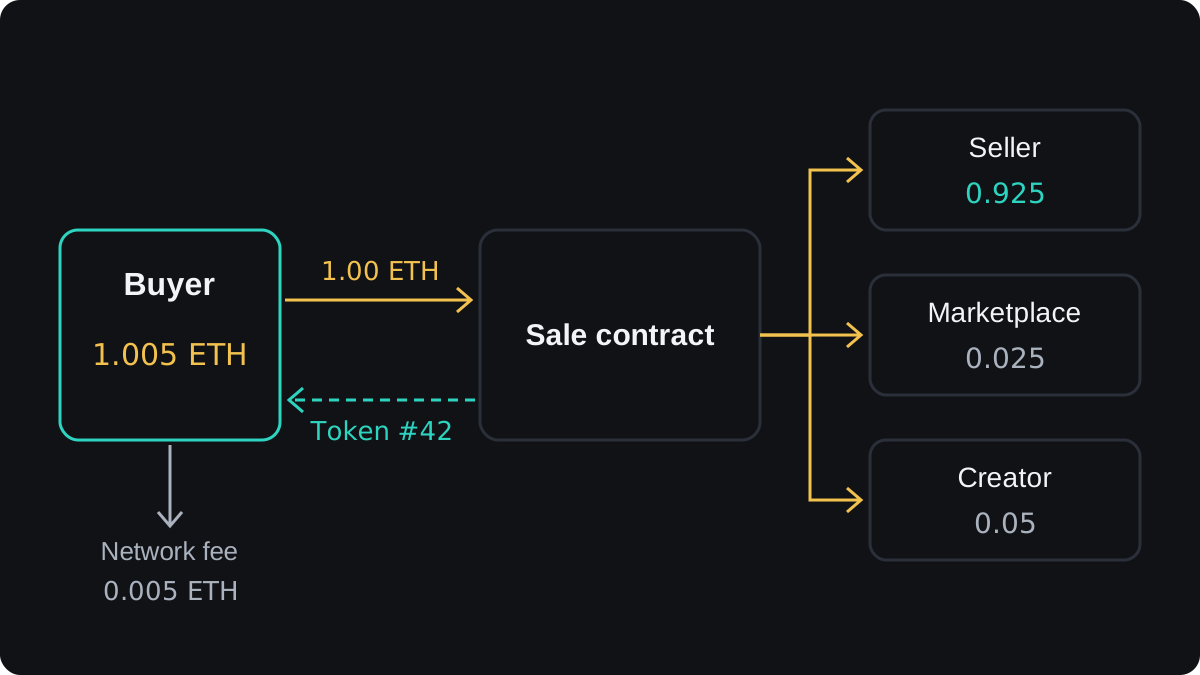
- The listing price is 1.00 ETH, and the network fee for your purchase is 0.005 ETH. You pay 1.005 ETH in total.
- On the seller's side, the marketplace keeps 2.5% of the price, which is 0.025 ETH.
- The collection asks for a 5% creator royalty, 0.05 ETH, if the marketplace pays it.
- The seller receives 1.00 minus 0.025 minus 0.05 = 0.925 ETH.
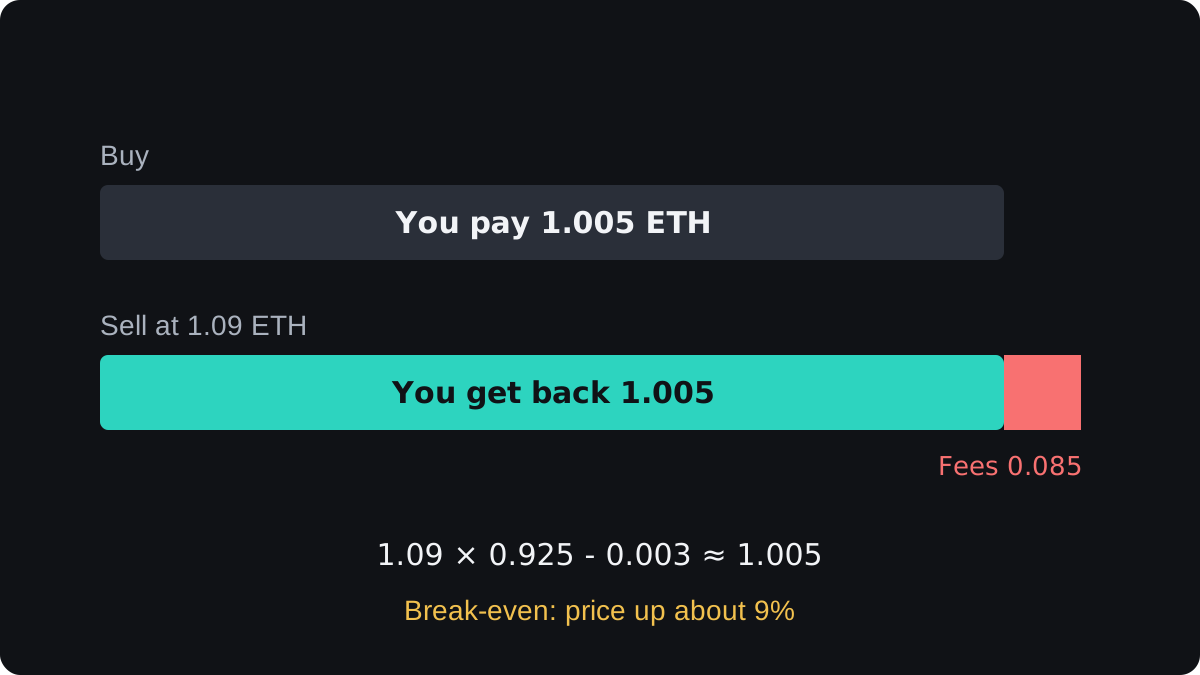
Now flip it. When you sell later, you are the one paying 7.5% in fees. You may also pay a network fee of about 0.003 ETH, illustrative again, for a one-time approval that lets the marketplace move your token.
To get 1.005 ETH back, the sale price P must satisfy P × 0.925 minus 0.003 = 1.005. So P = 1.008 ÷ 0.925 = 1.0897, about 1.09 ETH: a rise of about 9% just to break even.
Risks to check before you click
An NFT can only be sold to someone who wants that exact token. The floor price is the lowest asking price in a collection, and it shows what sellers hope for.
What you could get today is the best standing offer. It can sit far below the floor, or not exist at all, which is what thin liquidity looks like.
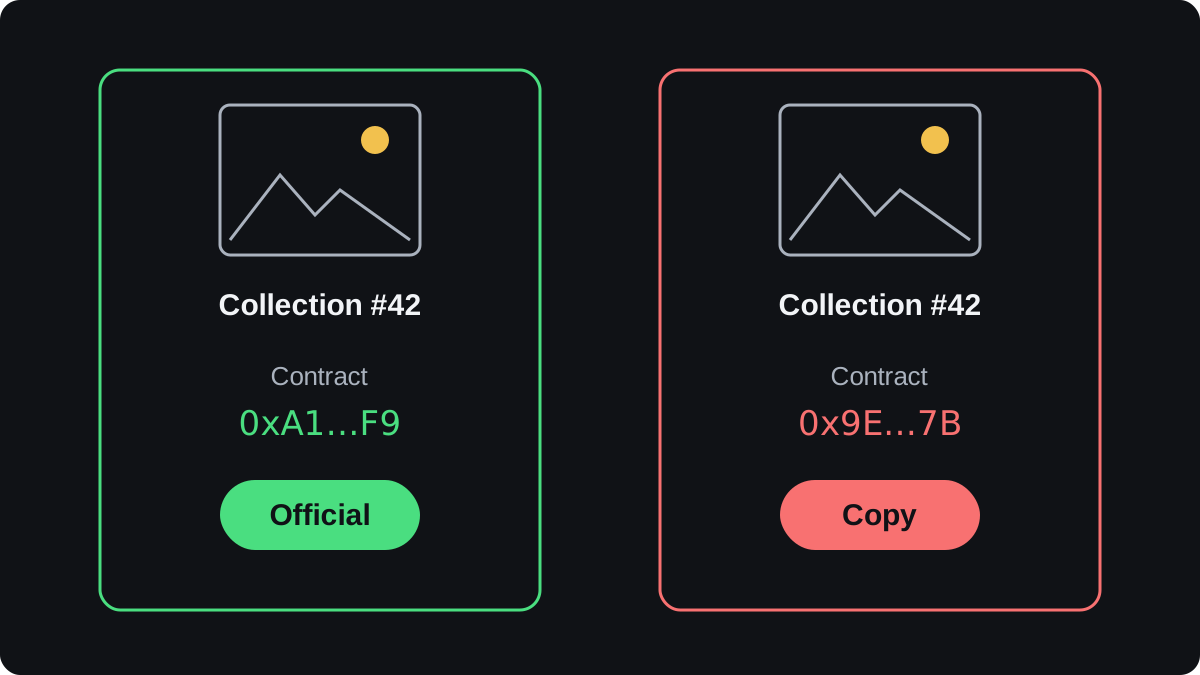
Anyone can deploy a contract with the same name and images as a famous collection. Marketplace badges help, but the contract address is the check that cannot be faked, so compare it every time.
A thief does not need your seed phrase if you sign the wrong request. Signing it can hand your tokens to someone else.
Fake mint pages, offers of a free claim, and unknown NFTs that land in your wallet with a link in their name are all after that signature. The lesson on spotting a crypto scam covers the warning signs.
Volume can be faked too. A seller can trade one token back and forth between their own wallets to make a collection look busy. A long list of recent sales is not proof of real buyers.
Câu hỏi thường gặp
Do I need a crypto wallet to buy an NFT?
In most cases, yes: a crypto wallet you control that supports the NFT's network. Some marketplaces take card payments and hold the token for you, which means they control it until you withdraw it.
Why did I pay more than the listed price?
The listed price leaves out the network fee for your transaction. That fee rises when the network is busy, and on most networks you pay it even if the purchase fails.
Who pays the creator royalty?
It comes out of the sale price, so the seller receives less. Whether it is paid at all depends on the marketplace and on how the collection's contract is written.
Can I get my money back if I buy a fake NFT?
Usually not. The transaction is final once it confirms, so checking the contract address before you buy is the protection that works.
Học tiếp
 Chương 2What is an NFT?An NFT, or non-fungible token, is a token on a blockchain with its own ID number, so no two are interchangeable. The blockchain records which address holds it. The token usually points to a file of details, called metadata, which links to an image or other item. Holding the token does not by itself give you the copyright.
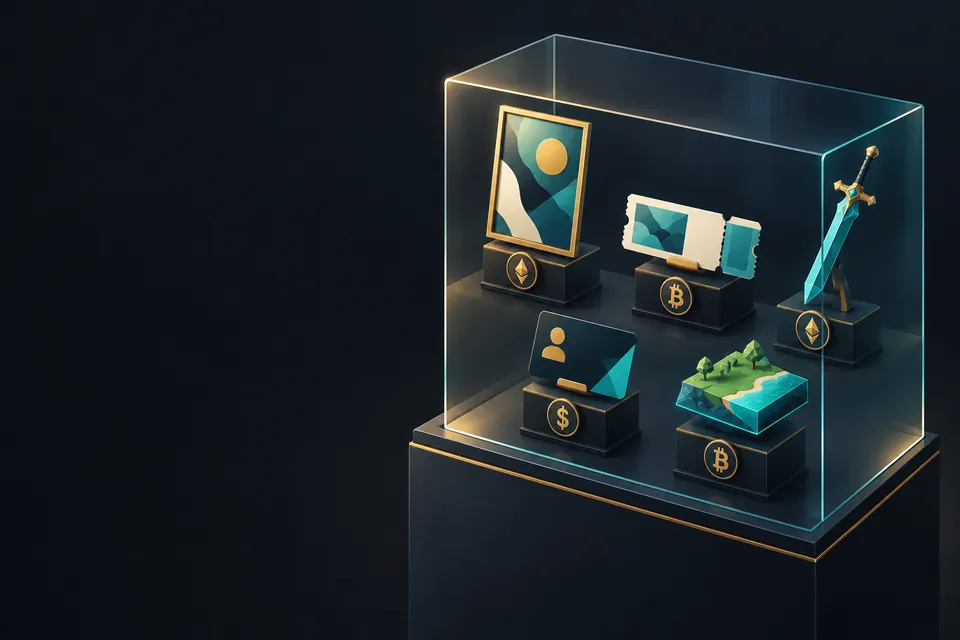 Chương 2What are NFTs used for?NFTs are used wherever it matters who holds one specific item: digital art and collectibles, event tickets and memberships, items inside games, blockchain names, and receipts for positions or physical goods. In each case the token proves which address holds the item, and the use depends on someone outside the chain honouring that record.
 Chương 2Should you buy or create NFTs?That depends on what you want the token for. A buyer should know what the token gives, who would buy it back and at what price, and whether losing the full amount is acceptable. A creator needs the rights to the work, an audience, and room in the budget for minting and selling fees.

