How does leverage work on crypto CFDs?
Leverage on a crypto CFD lets you open a position worth more than the margin you put up. At 1:10, a $6,000 bitcoin position locks $600. Leverage sets the margin and position size sets the risk. Because crypto moves fast, brokers and regulators usually allow far less leverage on crypto than on forex.
Nội dung này hiện chỉ có bản tiếng Anh.

You have $1,000 in your account and want to buy 0.10 lot of BTCUSD at an illustrative 60,000. At an illustrative contract size of 1 coin per lot, that is 0.1 BTC, a $6,000 position.
Without leverage you could not open it. With leverage the broker locks only part of the $6,000 as margin, while the price still moves the whole $6,000. This lesson follows both numbers.
How leverage and margin work on a crypto CFD
Leverage is written as a ratio such as 1:10, meaning $1 of margin holds $10 of position. The margin a trade locks is:
Margin = price × contract size × lots ÷ leverage
MetaTrader 5 uses this formula for CFDs whose margin depends on your leverage. A broker can also apply its own margin rate or a fixed margin per symbol, so trust the figure your platform shows.
For the $6,000 position, 1:10 locks $600 and 1:20 locks $300. At 1:2 or 1:5 the margin is more than the account holds, so the trade cannot be opened.
| Leverage | Margin rate | Margin for $6,000 |
|---|---|---|
| 1:2 | 50% | $3,000 |
| 1:5 | 20% | $1,200 |
| 1:10 | 10% | $600 |
| 1:20 | 5% | $300 |
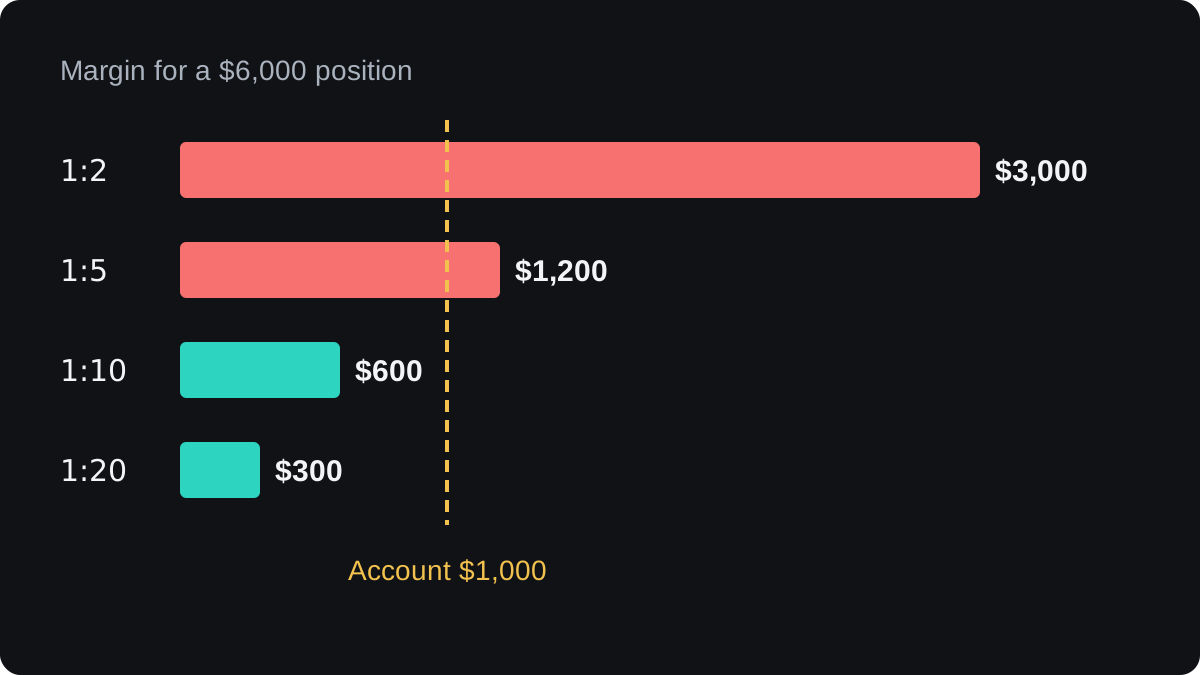
The mechanics are the same as in forex leverage. What differs is how much leverage you are allowed, and how fast the price moves.
Why leverage on crypto is set lower
Crypto prices can move several percent in a day, and far more in a week. A margin that would comfortably cover a forex trade can be used up by one crypto move.
For that reason a broker can set leverage for each symbol, so BTCUSD may get far less than your account's leverage.
MetaTrader 5 also lets a broker cut leverage as positions grow, at set days and hours such as weekends, or ahead of big events.
Regulators set ceilings too. In the European Union, retail clients can use at most 1:2 on crypto CFDs, against 1:30 on major currency pairs. ESMA set that limit in 2018, and national regulators have kept it since.
In the UK, firms have not been allowed to sell crypto CFDs to retail clients since January 2021. Rules like these can change, so check the ones that apply where you live.
So your account's headline leverage may not apply to BTCUSD. The margin section of the symbol's specification in MetaTrader 5 shows the rate that does.
Leverage sets the margin; size sets the risk
On 0.10 lot at 1 coin per lot, each $1 the price moves is worth $0.10. That stays true at 1:2, 1:10 or 1:20.
To see the real exposure, compare the position with your account. A $6,000 position on $1,000 of equity is an effective leverage of 6,000 ÷ 1,000 = 6:1, so every 1% move in the price is 6% of your account.
| Price fall | New price | Loss | Share of $1,000 |
|---|---|---|---|
| 2% | 58,800 | $120 | 12% |
| 5% | 57,000 | $300 | 30% |
| 10% | 54,000 | $600 | 60% |
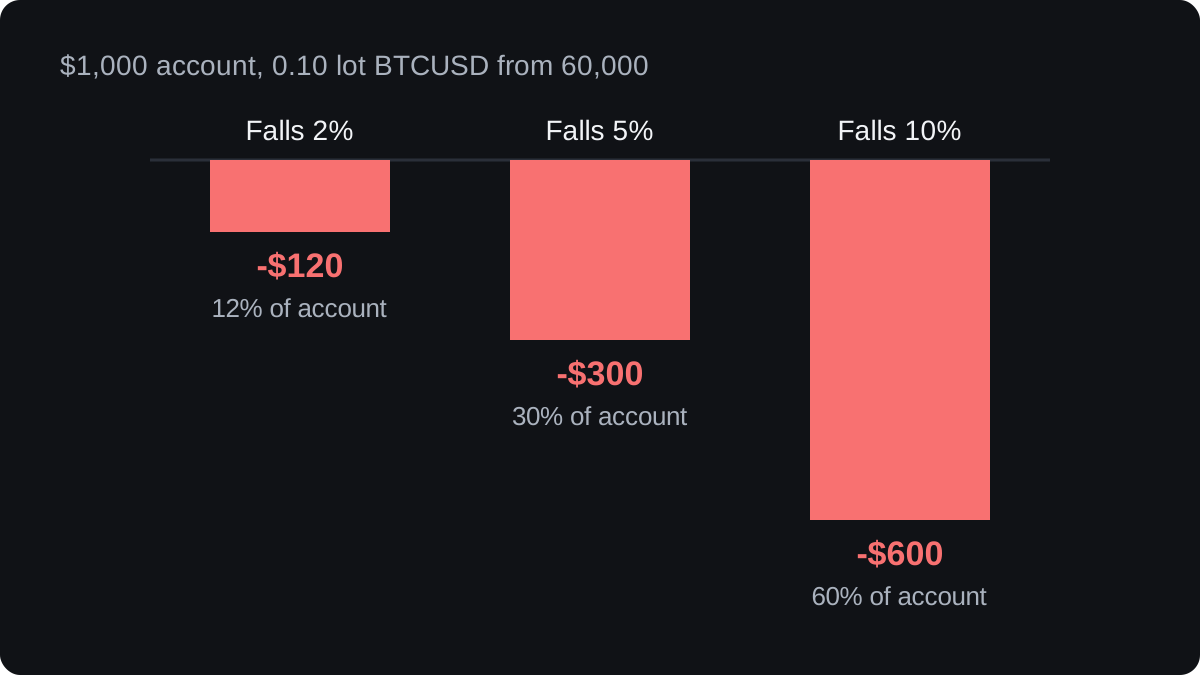
The usual fix is to size the trade from the loss you accept. Say you will risk $20 and place your stop $2,000 below entry. Size = $20 ÷ ($2,000 × 1) = 0.01 lot.
That 0.01 lot is a $600 position. It locks $300 of margin at 1:2 or $30 at 1:20, and the stop loses $20 in both cases. How to size a crypto position goes further.
Margin call and stop out on a crypto position
Brokers watch your margin level, which is equity ÷ margin × 100%. Each broker sets its own margin call and stop out levels; this example uses 100% and 50%. The forex lesson on margin and stop out explains both.
Back to the $1,000 account holding 0.10 lot at 60,000, this time at 1:20. Margin is $300, so the margin level starts at 1,000 ÷ 300 × 100% = 333%.
To keep the sums simple, margin is held at $300; on a real platform it can shift as the price moves.
- Margin call at 100%: equity has fallen to $300, a loss of $700. That is a move of $700 ÷ $0.10 = $7,000, so the price is 53,000.
- Stop out at 50%: equity is $150, a loss of $850. That is $8,500 below entry, at 51,500, a fall of about 14%.
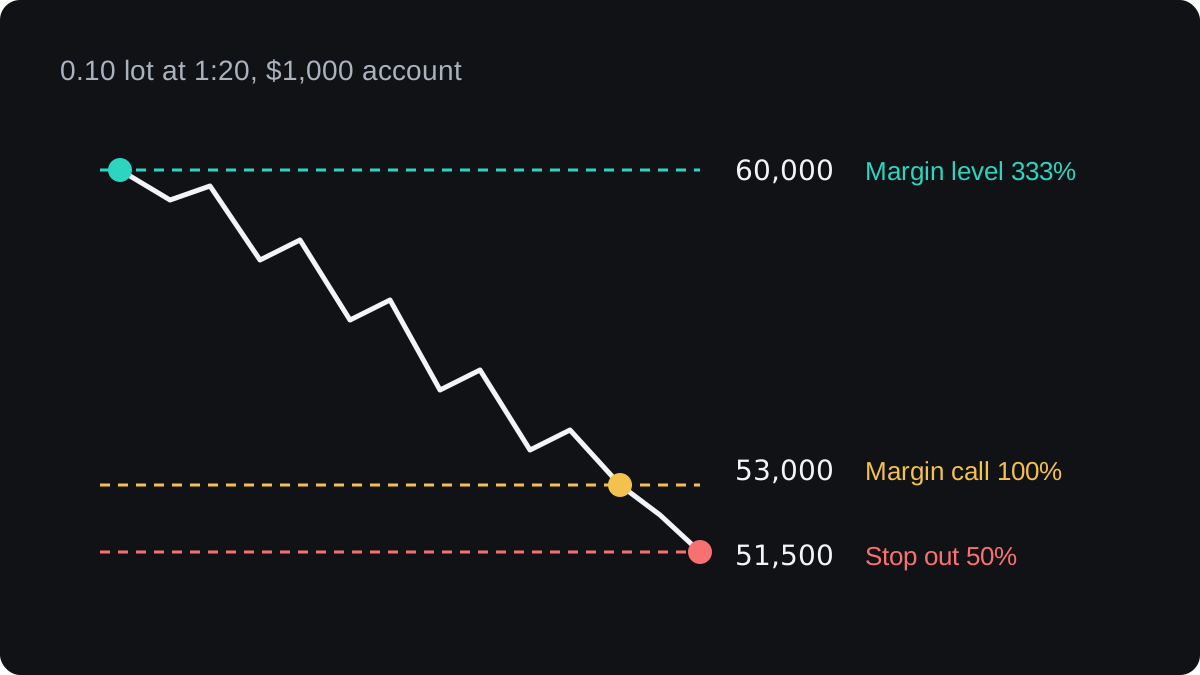
Falls of that size have happened in crypto within days, and sometimes within hours. A position this large leaves little room for them.
In this example, higher leverage moved the stop out further away. At 1:10, margin is $600 and the stop out comes at $300 of equity, at 53,000.
That is little comfort, because cheap margin is what let a $1,000 account open a $6,000 position in the first place, and that size is what does the damage.
Gaps can go past every level
A stop loss or a stop out closes at the next price available. If BTCUSD jumps from 53,000 straight to 49,000, nothing fills in between, and the gap is a form of slippage.
In the example, a close at 49,000 is a loss of 11,000 × $0.10 = $1,100, which is $100 more than the account held.
With negative balance protection, which EU rules require for retail clients, your loss is capped at the money in the account, so the extra $100 is not yours to pay. Without it you could owe the $100.
Gaps are likeliest when a crypto CFD has been paused while coins kept trading elsewhere, which trading crypto CFDs at weekends covers.
Câu hỏi thường gặp
What leverage can I use on bitcoin CFDs?
It depends on your broker, your account type and the rules where you live; EU retail clients, for example, are limited to 1:2. The margin section of the symbol's specification shows the rate that applies to you.
Why is leverage on crypto lower than on forex?
Crypto prices usually move much further in a day than major currency pairs. Lower leverage caps how large a position a deposit can open, which limits how much of the account one move can take.
Does higher leverage mean higher risk?
For the same position, a given move costs the same at 1:2 or 1:20. The danger is that higher leverage lets the same deposit open a much bigger position, and a bigger position loses more on every move.
Can I lose more than my margin on a crypto CFD?
Yes. Margin is only the deposit a trade locks, while the loss depends on the size and the move. It can reach your whole balance, or more after a gap if you have no negative balance protection.
Học tiếp
 Chương 2What is a crypto CFD?A crypto CFD is a contract with your broker that settles the change in a cryptocurrency's price in cash. You never own the coin, so you need no wallet or private key. You can buy or sell, profit or loss lands in your account currency, and the broker sets the contract's terms.
 Chương 2Buying coins vs trading crypto CFDs.Buying coins gives you the asset itself, which you can hold or send, and you must guard the keys. A crypto CFD gives you only the price change, settled in cash by your broker. CFDs make shorting and leverage easy but usually charge swap each night, so long holds tend to cost more.
 Chương 2What does it cost to trade crypto CFDs?Trading a crypto CFD costs the spread on every trade, commission on some account types, and swap for each night the position stays open. Slippage can add to the bill. The spread matters most on short trades and swap on long ones. Your broker sets every rate, so read them in the symbol's specification.
 Chương 2Trading crypto CFDs at weekends.Coins trade on exchanges seven days a week, but a crypto CFD trades only when your broker's sessions allow. Some brokers quote crypto CFDs through the weekend, others pause them. Either way, weekend markets can be thinner, spreads can widen, prices can gap, and swap may count Saturday and Sunday nights.

