How can you avoid a margin call?
Margin level is your equity divided by your used margin, and a margin call comes when it falls to your broker's threshold. To stay clear, keep positions small compared with your equity, set stop losses that close losing trades long before that point, and leave plenty of free margin unused.
Nội dung này hiện chỉ có bản tiếng Anh.

Before you open a trade, you can work out how far the price can move against you before your account reaches your broker's margin call line. Each method in this lesson makes that distance longer, or closes the trade before it is used up.
The lesson follows one $1,000 account through several choices. All prices, leverage settings and thresholds are round illustrative numbers.
What decides how close you are to a margin call?
Your platform shows a percentage called margin level. It compares the money in your account with the deposit your open trades tie up.
Margin level = equity ÷ used margin × 100%
Equity is your balance plus or minus the profit or loss on open trades. Used margin is the deposit your broker holds while those trades are open. A margin level of 200% means equity is twice the margin in use.
Your broker issues a margin call when the margin level falls to a set threshold, and starts closing positions if it keeps falling to the stop out level.
This lesson uses a 100% margin call. Brokers choose different numbers, so check your own broker's levels before you rely on any figure here.
Take one trade as the starting point. Your account holds $1,000 at 1:100 leverage, and you buy 0.50 lot of EUR/USD at 1.10000. Spread and other costs are left out to keep the sums clean.
- A standard lot is 100,000 units, so 0.50 lot is 50,000 euros, worth 50,000 × 1.10000 = $55,000.
- Used margin at 1:100 is $55,000 ÷ 100 = $550.
- Margin level at the start is $1,000 ÷ $550 × 100% = 181.8%.
- Each pip is worth 50,000 × 0.0001 = $5.
- A 100% margin call comes when equity falls to $550, a loss of $450.
- That loss is $450 ÷ $5 = 90 pips, so a fall to 1.09100 triggers the call.
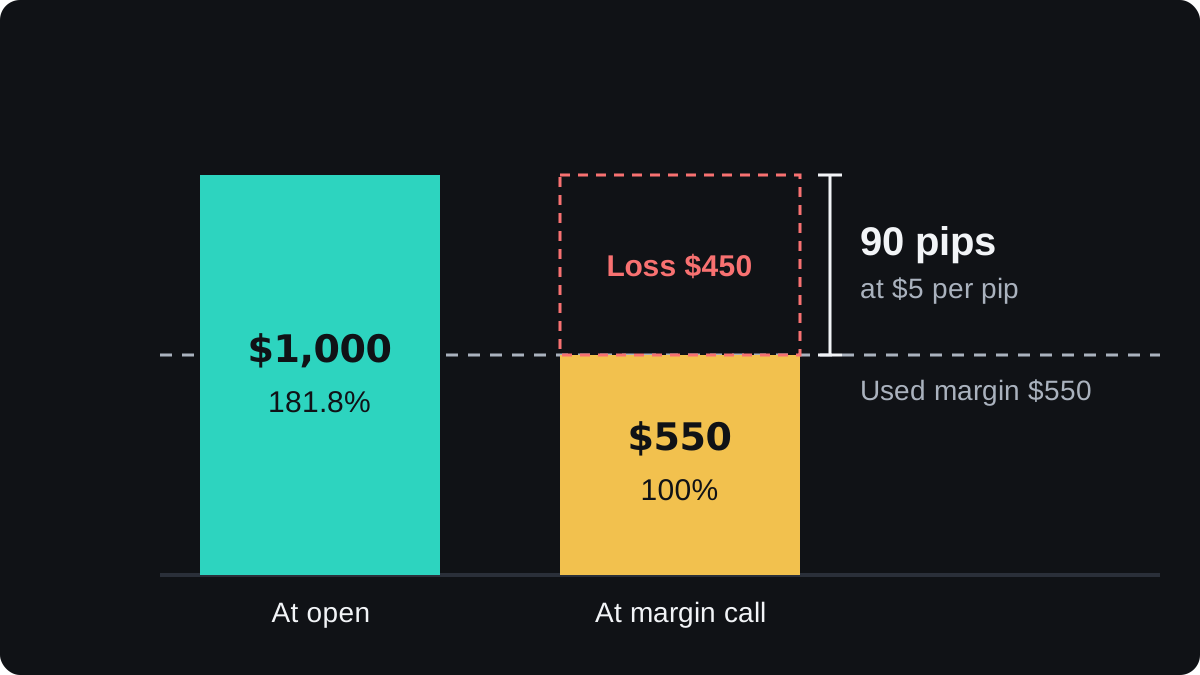
Some platforms recalculate used margin as the price moves, while others fix it at the opening rate. The example holds it at $550 to keep the arithmetic easy to follow.
EUR/USD can travel 90 pips in one busy day, so this trade leaves little room.
Why does a smaller position help so much?
A smaller trade improves both sides of the margin level sum. It ties up less margin and it loses less per pip, so the call moves away quickly.
The distance to the call for any trade comes from one formula, with the call level written as a decimal (100% is 1.00):
Pips to margin call = (equity minus call level × used margin) ÷ pip value
Here it is for three sizes in the same $1,000 account, with EUR/USD at 1.10000 and 1:100 leverage:
| Position | Used margin | Pip value | Margin level at open | Pips to a 100% call |
|---|---|---|---|---|
| 0.50 lot | $550 | $5 | 181.8% | 90 |
| 0.20 lot | $220 | $2 | 454.5% | 390 |
| 0.10 lot | $110 | $1 | 909.1% | 890 |
Going from 0.50 to 0.20 lot cuts the position by 60%, yet the room before the call grows from 90 to 390 pips, more than four times as much.
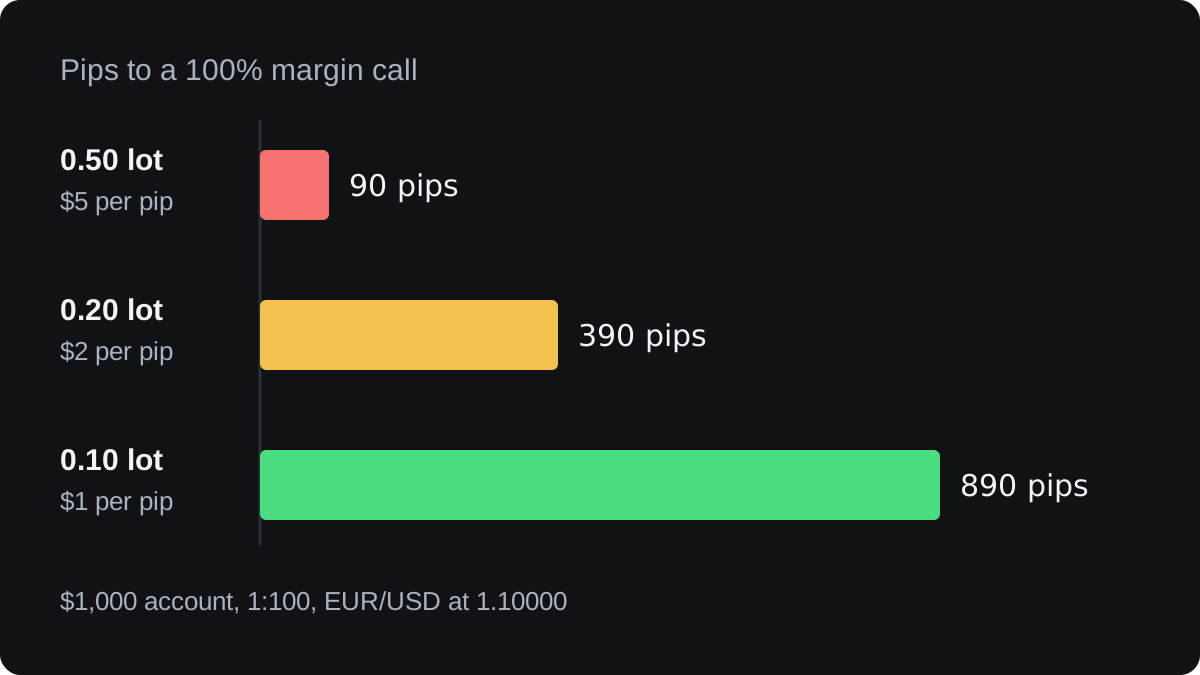
How small is small enough depends on where your stop sits and how much you plan to risk. The position size lesson works that out, and the margin calculator shows the margin for any pair and size.
How does a stop loss keep you away from the call?
A stop loss is an order that closes your trade at a price you set in advance. If it sits well inside the margin call distance, the trade ends with a small loss while your margin level is still high.
Take the 0.20 lot trade and place a stop 40 pips below the entry, at 1.09600:
- Loss at the stop: 40 × $2 = $80.
- Equity after the stop: $1,000 minus $80 = $920.
- Margin level just before the stop fills: $920 ÷ $220 × 100% = 418.2%.
- The 100% margin call would sit 390 pips below entry, at 1.06100, with a loss of $780.
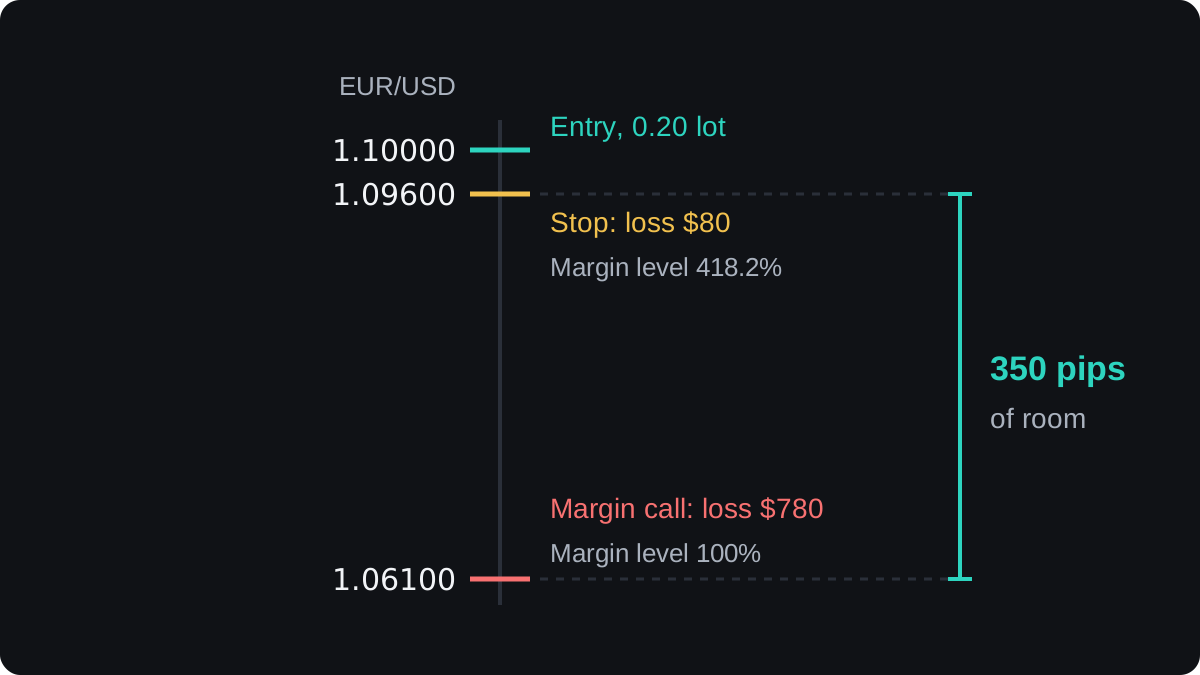
A stop does not promise its price. When the market jumps over a weekend or on a big news release, the order fills at the next available price, which can be worse than the one you set. That gap is called slippage.
A wide distance between your stop and the call leaves room for that kind of fill. Moving the stop further away after a trade turns against you gives that room away.
Is your free margin enough for every open trade?
Free margin is equity minus used margin. With a 100% margin call, free margin is exactly the loss you can take before the call. In the 0.50 lot example it was $1,000 minus $550 = $450, the same figure as above.
Every new trade draws on that pool. Open three 0.20 lot trades on EUR/USD and you use 3 × $220 = $660 of margin, leaving $340 free, while each pip now costs $6.
The call is then $340 ÷ $6 = 56.7 pips away. Each trade looked small alone, yet together they sit closer to the call than the single 0.50 lot trade did.
Different pairs can add up the same way. EUR/USD and GBP/USD often move in the same direction, so buying both works much like one larger bet against the US dollar. The correlation lesson shows how to check.
Adding to a losing trade drains free margin from both ends. Each new position takes more margin while the open loss is cutting your equity.
A deposit raises equity and lifts the margin level at once. If the trade keeps falling, the new money is exposed to the same loss, so spare margin planned in advance is safer.
The margin buffer lesson covers how large that spare margin could be for your account.
Does changing your account leverage help?
Account leverage sets how much margin each trade needs. It does not change what a pip is worth. Here is the same 0.20 lot trade, $1,000 account and EUR/USD price at three settings:
| Account leverage | Used margin | Margin level at open | Pips to a 100% call |
|---|---|---|---|
| 1:50 | $440 | 227.3% | 280 |
| 1:100 | $220 | 454.5% | 390 |
| 1:500 | $44 | 2,272.7% | 478 |
For the same trade, higher leverage holds less margin, so the call moves further away. Lower leverage does the opposite and brings the call closer.
The loss per pip is $2 in every row. Higher leverage also lets you open far larger trades with the same money, and a larger trade brings the call right back.
The effective leverage lesson measures your position size against your equity. The leverage you can choose depends on your broker and on the rules where you live.
Which habits keep your margin level healthy?
- Work out the pips to the call before you open a trade, and check your margin level again while trades are open.
- Trade smaller, or close positions, before major scheduled news and before the weekend if you would not accept a price gap.
- Count swap on positions held overnight, because a daily charge lowers your equity a little each night.
- Read your broker's margin terms, because some brokers raise margin requirements around big news or weekends, which lowers your margin level without any price move.
- Set a price alert well above the margin call price, so you hear about trouble while you still have choices.
Câu hỏi thường gặp
What margin level triggers a margin call?
Each broker sets its own number, and the account type can change it too. This lesson uses 100% as an illustration; your account terms give the real figure.
Does a stop loss prevent a margin call?
It usually does if it closes the trade while your margin level is still far above the threshold. In a fast market or a weekend gap the stop can fill at a worse price, so keep your position small as well.
Should I deposit more money after a margin call?
A deposit raises your equity and margin level, so it ends the call for now. If the trade keeps moving against you, the extra money can be lost too, so first decide whether the trade still makes sense.
How much free margin should I keep?
There is no single right amount. A practical test is to work out how many pips your open trades can lose before the call and make sure that distance is far larger than your stops.
Does lower leverage reduce the risk of a margin call?
For the same position, lower account leverage holds more margin and brings the call closer. What reduces the risk is a smaller position compared with your equity.
Học tiếp
 Chương 6What is margin trading?Margin trading means opening a position worth more than the money in your account. The broker sets aside part of your balance, the margin, as a deposit while the trade is open. Profit and loss are counted on the full position size, so small price moves change your balance much faster than the margin suggests.
 Chương 6What is account balance in forex?Your account balance is the money in your trading account from deposits, withdrawals and closed trades, after booked costs such as commission and swap. It does not include open positions. While a trade is open the balance stays the same, and the floating profit or loss shows up in your equity instead.
 Chương 6What is floating (unrealized) profit and loss?Floating profit and loss is the result your open trades would show if you closed them at the current price. It changes with every tick and moves your equity, while your balance stays the same. It becomes realized, and is added to or taken from your balance, only when the trade closes.
 Chương 6Margin, margin level và stop out trong forex là gì?Margin là phần tiền sàn giữ lại làm khoản đặt cọc trong lúc một lệnh dùng đòn bẩy còn mở. Margin level bằng equity chia cho margin đã dùng, nhân 100%. Khi nó rơi xuống mức margin call của sàn, tài khoản bị gắn cờ cảnh báo, và tới mức stop out, sàn bắt đầu tự động đóng các lệnh của bạn.
 Chương 6What is used margin?Used margin is the total amount your broker sets aside to keep all your open positions open. Each position's margin is its notional value divided by your leverage, and used margin adds them up. It is not a fee: the money returns to free margin when you close the trades.
 Chương 6What is equity in a trading account?Equity is your account balance plus or minus the floating profit or loss of your open trades. It shows what the account would be worth if you closed everything at current prices. With no trades open, equity equals balance. Brokers use it to work out free margin, margin level and stop outs.
 Chương 6What is free margin?Free margin is the money in your trading account that is not locked up as margin for open trades. It equals equity minus used margin. You need free margin to open new positions, and it falls as open trades lose and rises as they gain. At zero, your margin level is 100%.
 Chương 6What is margin level?Margin level is your equity divided by your used margin, multiplied by 100 and shown as a percentage. It tells you how much cushion your open trades have. At 100%, equity equals used margin and free margin is zero. Brokers set their margin call and stop out levels on this number, and the levels differ between brokers.
 Chương 6What is a margin call?A margin call is your broker's warning that your margin level, equity divided by used margin, has fallen to a set threshold such as 100%. You usually cannot open new trades from that point. The call closes nothing by itself. If losses continue, the broker's stop out level is where positions start to be closed for you.
 Chương 6What is a stop out level?The stop out level is the margin level at which your broker starts closing your open positions automatically, often beginning with the largest loss. If your stop out level is 50%, closing begins when equity falls to half your used margin. It is meant to stop your account sinking further, though a price gap can still push it below zero.
 Chương 6Margin call example: margin call at 100% with no separate stop out.When a broker sets the margin call and the stop out both at 100%, the warning and the forced close happen at the same moment. In this example, a $1,000 account buys 0.50 lot of EUR/USD with $550 of margin at 1:100, and the trade is closed after a 90 pip fall, a $450 loss.
 Chương 6Margin call and stop out example: 100% and 50%.In this example a $2,000 account buys 1 lot of EUR/USD at 1.10000 with $1,100 of used margin. The margin call at 100% arrives when equity falls to $1,100, 90 pips lower at 1.09100. The stop out at 50% closes the trade when equity reaches $550, at 1.08550, a loss of $1,450.
 Chương 6What happens if you trade forex with $100?With $100 and 1:100 leverage, 0.01 lot of EUR/USD at 1.10000 uses $11 of margin and can move about 890 pips against you before a 100% margin call. At 0.05 lot the margin call comes after 90 pips, and 0.10 lot cannot be opened at all. Trade size decides how much room you have.
 Chương 6Why margin call and stop out levels differ between brokers.Margin call and stop out levels are set by each broker, often per account type, within any rules from the regulator that licenses the account. In this lesson's example, one trade is closed after 90 pips at one broker and after 178 pips at another, so look up your own levels before you trade.
 Chương 6Đòn bẩy trong forex là gì?Đòn bẩy cho bạn nắm một vị thế lớn hơn nhiều so với số tiền đặt cọc. Ở 1:100, mỗi $1 margin (ký quỹ) giữ được $100 tiền tệ, nên vị thế $110,000 cần $1,100. Đòn bẩy quyết định bao nhiêu margin bị giữ lại, không quyết định một pip đáng giá bao nhiêu. Rủi ro thật của bạn đến từ khối lượng lệnh bạn chọn.
 Chương 6Margin cheat sheet.Balance is the cash from deposits, withdrawals and closed trades. Equity is balance plus the floating profit or loss on open trades. Used margin is the deposit your open trades hold, and free margin is equity minus used margin. Margin level is equity divided by used margin, times 100. A margin call warns; a stop out closes trades.

