What is used margin?
Used margin is the total amount your broker sets aside to keep all your open positions open. Each position's margin is its notional value divided by your leverage, and used margin adds them up. It is not a fee: the money returns to free margin when you close the trades.
Nội dung này hiện chỉ có bản tiếng Anh.

Open a trade and a number appears in your platform's Margin field. Open a second trade and that number grows. Close both and it drops back to zero.
That running total is your used margin: the total amount your broker sets aside to keep all your open positions open. It is still your money, held as a deposit while the trades run.
Where do you see used margin on your platform?
In MetaTrader 4 and 5, look at the Trade tab. The summary line under your open positions shows Balance, Equity, Margin, Free margin and Margin level. The Margin figure there is your used margin.
Other platforms may call it margin used or required margin. With no open positions it reads zero, and a pending order that has not filled usually adds nothing, because there is no position yet.
On MetaTrader 5 a broker can set a margin rate for pending orders, so check your platform.
The lesson on margin, margin level and stop out showed the deposit for a single trade. Used margin is the same idea applied to your whole account at once.
How is the margin for one position worked out?
For a currency pair the usual rule is simple. Take the notional value of the position, its full face amount in your account currency, and divide it by your leverage.
A standard lot is 100,000 units of the base currency. The examples below use a US dollar account and leverage of 1:100. Both the prices and the leverage are illustrative.
First, a buy of 0.50 lot of EUR/USD at 1.10000:
- 0.50 lot is 50,000 euros.
- In dollars that is 50,000 × 1.10000 = $55,000.
- Divide by the leverage: $55,000 ÷ 100 = $550.
Next, a sell of 0.30 lot of USD/JPY at 150.00:
- 0.30 lot is 30,000 US dollars.
- The base currency is already your account currency, so the notional is $30,000 and the price does not enter the sum.
- Divide by the leverage: $30,000 ÷ 100 = $300.
Gold, indices, oil and crypto often have their own margin rates, set per instrument. Read the contract specification for those, or let the margin calculator do the sum.
How do you add up used margin across several trades?
Suppose you also buy 0.20 lot of GBP/USD at 1.30000. That is 20,000 pounds, or 20,000 × 1.30000 = $26,000, so its margin is $26,000 ÷ 100 = $260.
Your used margin is the three deposits added together:
| Position | Notional in USD | Margin at 1:100 |
|---|---|---|
| Buy 0.50 lot EUR/USD at 1.10000 | $55,000 | $550 |
| Sell 0.30 lot USD/JPY at 150.00 | $30,000 | $300 |
| Buy 0.20 lot GBP/USD at 1.30000 | $26,000 | $260 |
| Total | $111,000 | $1,110 |
Direction makes no difference here. A sell needs margin in the same way a buy does, so $550 + $300 + $260 = $1,110.
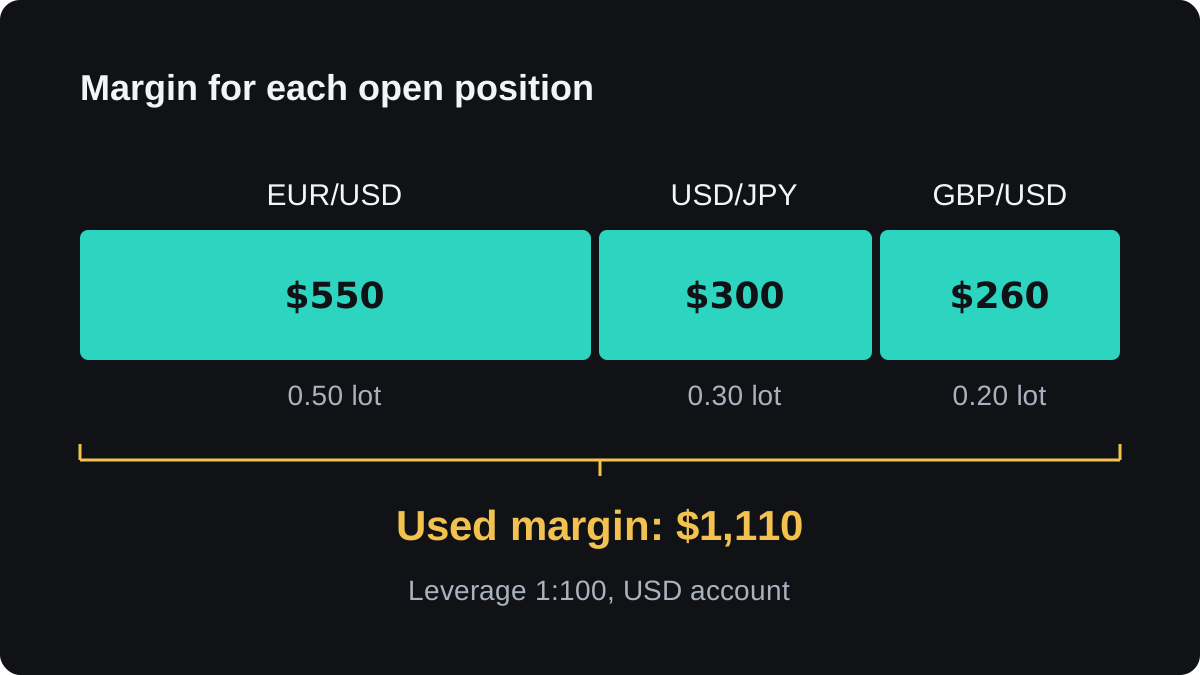
Close the USD/JPY trade and used margin falls by $300 to $810 straight away. Close half of the EUR/USD trade and its share drops from $550 to $275.
How does used margin connect to equity and free margin?
Say the account balance is $5,000 and the three trades together show a floating loss of $100. Your equity, the balance plus or minus open profit and loss, is $4,900.
Free margin is the equity that is not tied up: $4,900 minus $1,110 = $3,790. That is what remains to open new trades or absorb losses.
Margin level compares the two: equity ÷ used margin × 100. Here it is 4,900 ÷ 1,110 × 100 = 441.4%.
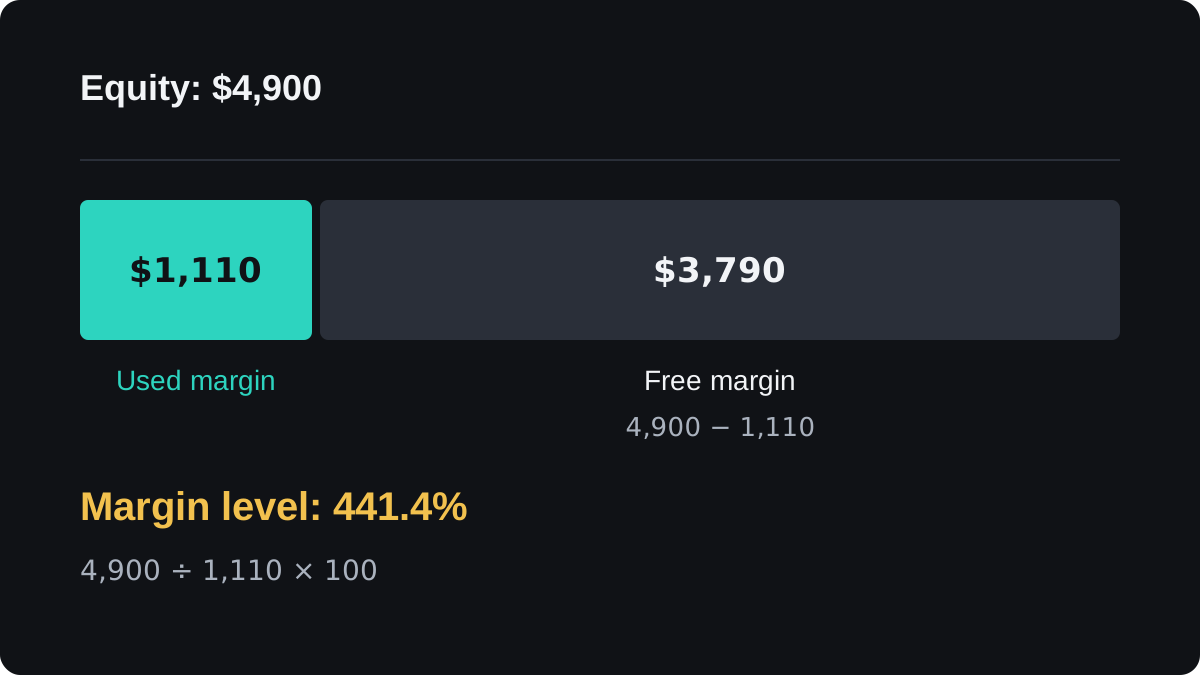
Used margin sits in both formulas, and it barely moves while the trades stay open. Losses shrink equity, so free margin and margin level fall while used margin stays roughly where it was.
If margin level drops to your broker's threshold, you get a margin call. Lower used margin gives a higher margin level for the same equity.
What makes used margin go up or down?
Opening, adding to or closing positions is the obvious cause. Every lot you add brings its own deposit, and every lot you close releases one.
Leverage changes the size of each deposit. The same three trades need $111,000 ÷ 30 = $3,700 at 1:30, $1,110 at 1:100 and $111,000 ÷ 500 = $222 at 1:500.
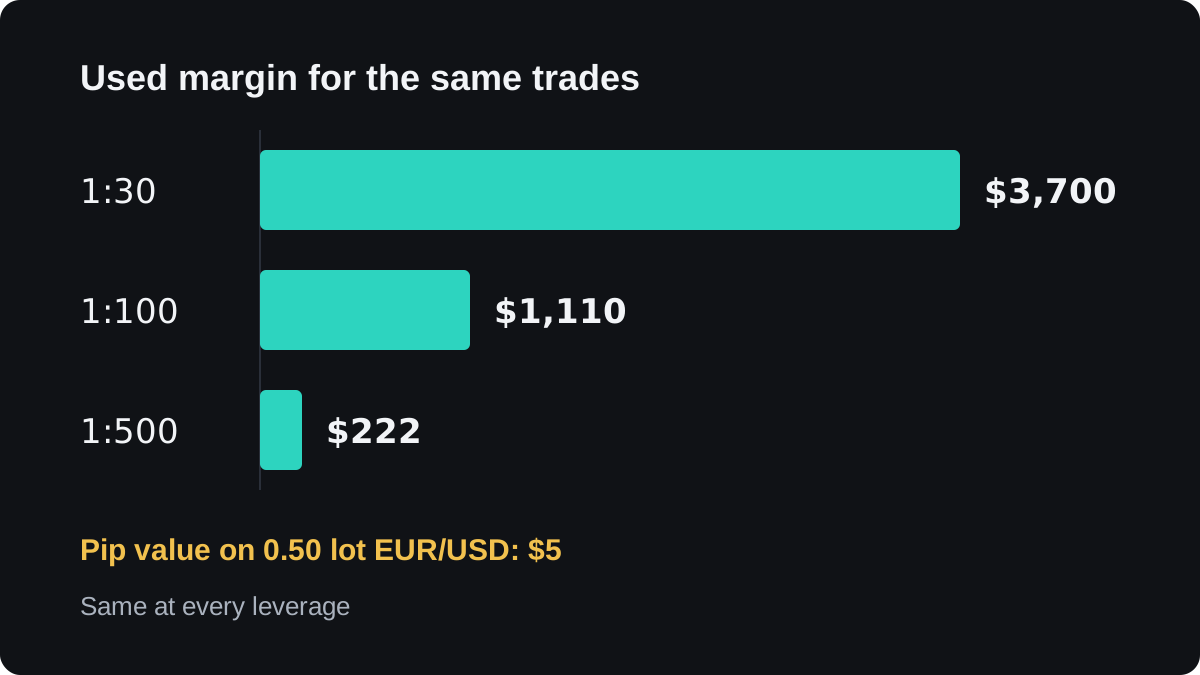
Leverage changes only the deposit. A pip on 0.50 lot of EUR/USD is worth 0.50 × $10 = $5 at every leverage setting, so the profit or loss from each move is identical.
Exchange rates matter when the base currency is not your account currency. The EUR/USD trade needs 500 euros of margin, which is $550 at 1.10000 but 500 × 1.12000 = $560 if the rate rises to 1.12000.
Some platforms recalculate that figure as the rate moves, while others fix it at the opening price. The USD/JPY trade has no such drift in a dollar account, because its notional is already in dollars.
Hedges are treated differently between brokers. If you hold a buy and a sell of the same size on one pair, some brokers charge margin on one side only, or a reduced amount.
Some brokers also raise requirements for very large positions, or for periods around major news and weekends. Their margin or leverage page explains when, and that page is the place to check.
What used margin does not tell you
Used margin is not a fee. Nothing leaves your balance when it is set aside, and it returns to free margin as soon as the position closes.
It is not your maximum loss either. The EUR/USD trade holds $550 of margin, yet a 200 pip move against 0.50 lot costs 200 × $5 = $1,000, almost twice the deposit.
A small used margin can also hide a large position. At 1:500 the three trades hold only $222, but they still control $111,000 of currency against $4,900 of equity, about 22.7 times.
Câu hỏi thường gặp
Is used margin money I have lost?
No. It is a deposit held from your equity while trades are open, and it is released when you close them. Losses and gains come from price moves, which change your equity.
How do I calculate used margin?
Work out each position's notional value in your account currency and divide it by your leverage. Then add the results for all open positions.
Why did my used margin change when I did not trade?
If a position's base currency differs from your account currency, the margin can move with the exchange rate. Your broker may also have changed its margin requirements, for example before major news.
Does a pending order use margin?
Usually not until it fills. Once it becomes a position, its margin is added to your used margin, and the order can be rejected if free margin is too low.
What is the difference between used margin and free margin?
Used margin is the part of your equity tied up by open trades. Free margin is the rest: equity minus used margin.
Học tiếp
 Chương 6What is margin trading?Margin trading means opening a position worth more than the money in your account. The broker sets aside part of your balance, the margin, as a deposit while the trade is open. Profit and loss are counted on the full position size, so small price moves change your balance much faster than the margin suggests.
 Chương 6What is account balance in forex?Your account balance is the money in your trading account from deposits, withdrawals and closed trades, after booked costs such as commission and swap. It does not include open positions. While a trade is open the balance stays the same, and the floating profit or loss shows up in your equity instead.
 Chương 6What is floating (unrealized) profit and loss?Floating profit and loss is the result your open trades would show if you closed them at the current price. It changes with every tick and moves your equity, while your balance stays the same. It becomes realized, and is added to or taken from your balance, only when the trade closes.
 Chương 6Margin, margin level và stop out trong forex là gì?Margin là phần tiền sàn giữ lại làm khoản đặt cọc trong lúc một lệnh dùng đòn bẩy còn mở. Margin level bằng equity chia cho margin đã dùng, nhân 100%. Khi nó rơi xuống mức margin call của sàn, tài khoản bị gắn cờ cảnh báo, và tới mức stop out, sàn bắt đầu tự động đóng các lệnh của bạn.
 Chương 6What is equity in a trading account?Equity is your account balance plus or minus the floating profit or loss of your open trades. It shows what the account would be worth if you closed everything at current prices. With no trades open, equity equals balance. Brokers use it to work out free margin, margin level and stop outs.
 Chương 6What is free margin?Free margin is the money in your trading account that is not locked up as margin for open trades. It equals equity minus used margin. You need free margin to open new positions, and it falls as open trades lose and rises as they gain. At zero, your margin level is 100%.
 Chương 6What is margin level?Margin level is your equity divided by your used margin, multiplied by 100 and shown as a percentage. It tells you how much cushion your open trades have. At 100%, equity equals used margin and free margin is zero. Brokers set their margin call and stop out levels on this number, and the levels differ between brokers.
 Chương 6What is a margin call?A margin call is your broker's warning that your margin level, equity divided by used margin, has fallen to a set threshold such as 100%. You usually cannot open new trades from that point. The call closes nothing by itself. If losses continue, the broker's stop out level is where positions start to be closed for you.
 Chương 6What is a stop out level?The stop out level is the margin level at which your broker starts closing your open positions automatically, often beginning with the largest loss. If your stop out level is 50%, closing begins when equity falls to half your used margin. It is meant to stop your account sinking further, though a price gap can still push it below zero.
 Chương 6Margin call example: margin call at 100% with no separate stop out.When a broker sets the margin call and the stop out both at 100%, the warning and the forced close happen at the same moment. In this example, a $1,000 account buys 0.50 lot of EUR/USD with $550 of margin at 1:100, and the trade is closed after a 90 pip fall, a $450 loss.
 Chương 6Margin call and stop out example: 100% and 50%.In this example a $2,000 account buys 1 lot of EUR/USD at 1.10000 with $1,100 of used margin. The margin call at 100% arrives when equity falls to $1,100, 90 pips lower at 1.09100. The stop out at 50% closes the trade when equity reaches $550, at 1.08550, a loss of $1,450.
 Chương 6What happens if you trade forex with $100?With $100 and 1:100 leverage, 0.01 lot of EUR/USD at 1.10000 uses $11 of margin and can move about 890 pips against you before a 100% margin call. At 0.05 lot the margin call comes after 90 pips, and 0.10 lot cannot be opened at all. Trade size decides how much room you have.
 Chương 6Why margin call and stop out levels differ between brokers.Margin call and stop out levels are set by each broker, often per account type, within any rules from the regulator that licenses the account. In this lesson's example, one trade is closed after 90 pips at one broker and after 178 pips at another, so look up your own levels before you trade.
 Chương 6Đòn bẩy trong forex là gì?Đòn bẩy cho bạn nắm một vị thế lớn hơn nhiều so với số tiền đặt cọc. Ở 1:100, mỗi $1 margin (ký quỹ) giữ được $100 tiền tệ, nên vị thế $110,000 cần $1,100. Đòn bẩy quyết định bao nhiêu margin bị giữ lại, không quyết định một pip đáng giá bao nhiêu. Rủi ro thật của bạn đến từ khối lượng lệnh bạn chọn.
 Chương 6Margin cheat sheet.Balance is the cash from deposits, withdrawals and closed trades. Equity is balance plus the floating profit or loss on open trades. Used margin is the deposit your open trades hold, and free margin is equity minus used margin. Margin level is equity divided by used margin, times 100. A margin call warns; a stop out closes trades.
 Chương 6How can you avoid a margin call?Margin level is your equity divided by your used margin, and a margin call comes when it falls to your broker's threshold. To stay clear, keep positions small compared with your equity, set stop losses that close losing trades long before that point, and leave plenty of free margin unused.

