When the carry trade unwinds.
A carry trade unwinds when many holders close it at once, usually after a risk-off shock or a change in interest rate expectations. The low-yield funding currency, such as the yen, jumps, and the carry pair can fall in days by more than the trade earned in months or years of swap.
本頁目前僅提供英文版。

For months, a carry trade can feel calm. The price drifts up and the swap is credited every night. Then, in a few days, the price can fall by more than a year of swap was worth.
That fall is called an unwind: many holders of the same trade close it at the same time. The swap you met in how carry shows up in your swap cannot protect you from it, and the numbers below show why.
What does a carry trade unwind look like?
Take an illustrative long position of 1 lot of AUD/JPY. In this carry trade you buy the Australian dollar, the higher-yielding currency, and sell the yen, the low-yielding funding currency. The broker credits an illustrative ¥500 swap each night.
You enter at 96.00. Over 120 days the pair climbs to 100.00, a gain of 400 pips. On a JPY pair a pip is 0.01, so 1 lot moves ¥1,000 per pip and the open profit reaches ¥400,000.
Then a shock hits, and in five days AUD/JPY falls from 100.00 to 94.00, a drop of 600 pips.
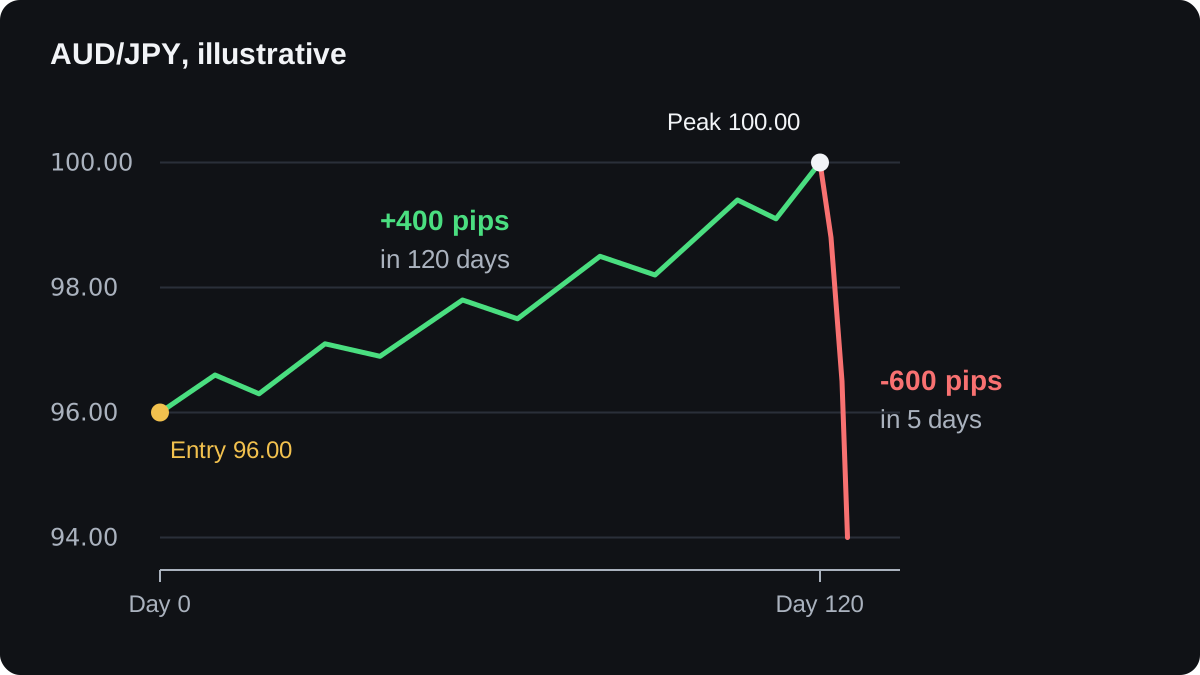
Carry pairs often move this way, gaining slowly and falling suddenly. Academic studies of carry returns describe the pattern as negative skew: many small gains and a few large losses.
Why can the swap not cover a sharp drop?
All numbers below are illustrative and use 1 lot, which is 100,000 Australian dollars.
- Swap during the climb: 120 nights × ¥500 = ¥60,000.
- Pip value: 100,000 × 0.01 = ¥1,000 per pip.
- Drop from the peak: 100.00 − 94.00 = 6.00, which is 600 pips.
- Loss from the peak: 600 × ¥1,000 = ¥600,000.
- Nights of swap needed to earn that back: ¥600,000 ÷ ¥500 = 1,200 nights, more than three years.
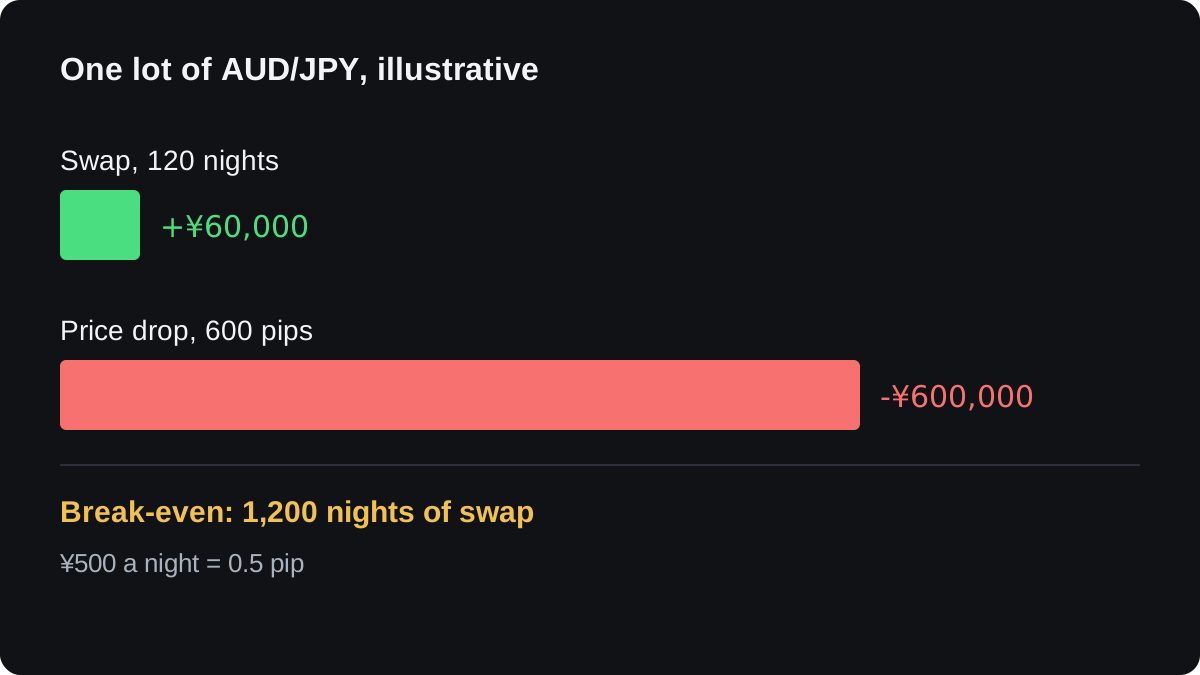
Measured from your entry, the trade ends 200 pips down, a loss of ¥200,000. Add the swap from all 125 nights, 125 × ¥500 = ¥62,500, and you are still ¥137,500 behind.
A swap of ¥500 on a pip worth ¥1,000 is half a pip a night. A pair like AUD/JPY often moves 50 pips or more in a single day, so price movement decides the result far more than swap does.
Why do risk-off moves hit carry pairs first?
In a calm market, investors hold higher-yielding currencies to earn the interest gap. When fear rises, a mood traders call risk-off, they cut risky positions, and carry trades are among the first to go.
Closing a long AUD/JPY trade means selling Australian dollars and buying yen. When many accounts and funds do this together, the yen rises and the pair falls, even if nothing has changed in Japan.
The fall then triggers more selling. Stop losses are hit, and leveraged accounts get margin calls or are closed by the broker, which sells the pair again.
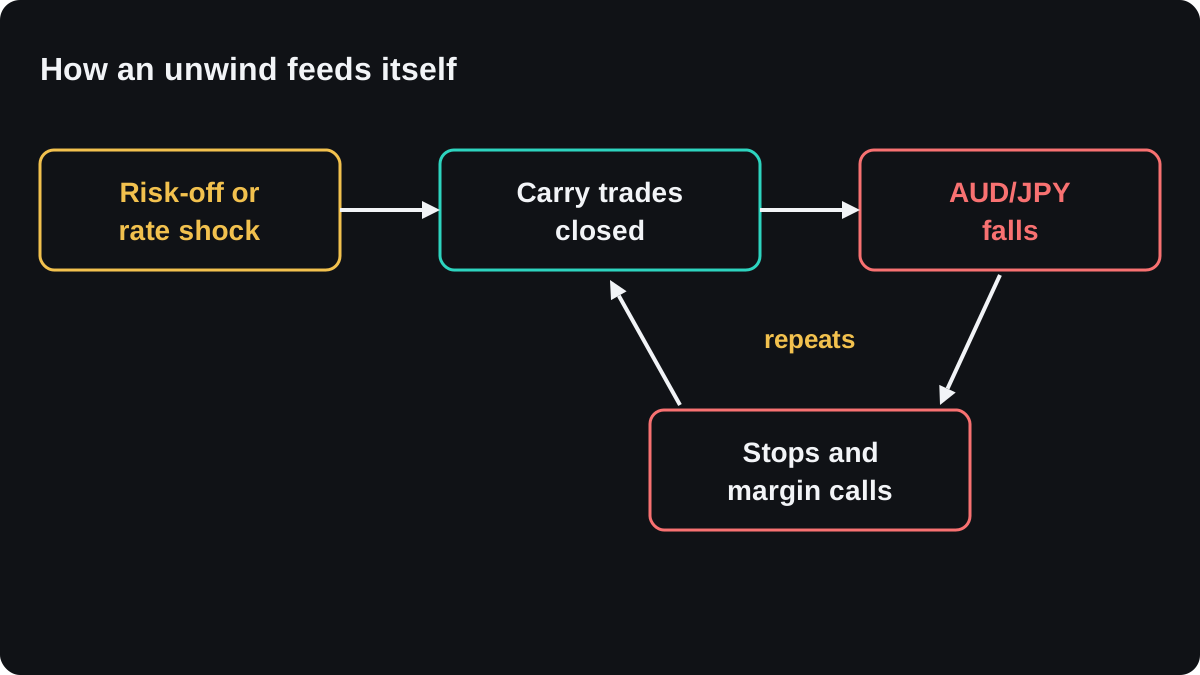
Trading can also thin out in these moments, so prices can jump past stop levels. A stop at 97.00 might fill at 96.80, 20 pips worse than planned.
The yen and the Swiss franc have often been used as funding currencies because their interest rates were low for long periods. The yen carry trade unwound sharply in late 2008, during the global financial crisis.
How do rate changes undo a carry trade?
The whole trade rests on an interest rate gap. Start with an illustrative gap of 3.50 percentage points and three ways it can shrink:
| Case | High-yield rate | Funding rate | Rate gap |
|---|---|---|---|
| Start | 4.00% | 0.50% | 3.50 points |
| Funding bank raises | 4.00% | 1.00% | 3.00 points |
| High-yield bank cuts | 3.00% | 0.50% | 2.50 points |
| Both move | 3.00% | 1.00% | 2.00 points |
Your swap shrinks as the gap shrinks, and it can turn negative once the broker's markup is larger than the gap. That change comes late, because swap follows overnight rates, which move only when a central bank actually acts.
The price reacts much faster, because it moves on expectations.
If traders start to expect a rate rise in the funding currency or a cut in the high-yield one, they may close carry trades weeks before any decision. The interest rates lesson explains why expectations matter so much.
Surprises do the most damage, because crowded positions have no time to adjust. In early August 2024 the yen carry trade unwound quickly after a Bank of Japan rate rise was followed by weak US jobs data.
What does an unwind do to your account?
Position size and leverage turn those pips into money. Say your account holds $10,000 and USD/JPY is at 150.00, both illustrative.
- Position value at entry: 100,000 AUD × 96.00 = ¥9,600,000, and ¥9,600,000 ÷ 150.00 = $64,000.
- Effective leverage: $64,000 ÷ $10,000 = 6.4 times.
- The 600 pip drop from the peak costs ¥600,000, and ¥600,000 ÷ 150.00 = $4,000, equal to 40% of the $10,000 you started with.
The exchange rate can add to the damage. Your loss is in yen, and an unwind usually strengthens the yen against the dollar too. If USD/JPY falls to 140.00 during the drop, the same ¥600,000 converts to $4,285.71.
Larger positions and late entries make it worse. Buy 3 lots at the peak of 100.00 and the same 600 pip drop costs ¥1,800,000, or $12,000 at 150.00, which is more than the whole account.
The broker's stop out would close that position before the bottom, at whatever price the market offers.
How do traders limit unwind risk?
None of these habits removes the risk, and each has a cost. They are ways traders who hold carry positions try to keep an unwind survivable.
- Size the position from the stop distance and the money you accept losing, and leave the swap out of the sum. A trade that only looks worth holding because of swap still carries price risk many times larger.
- Treat AUD/JPY, NZD/JPY and other yen carry pairs as one bet. In an unwind they tend to fall together, as correlation and portfolio risk explains.
- Check the economic calendar for central bank meetings in both currencies, since a rate surprise can start the move.
- Keep free margin well above the minimum, so a fast drop does not force the broker to close the trade at a poor price.
- Expect stops to slip in a fast market, which means the real loss can be larger than the planned one.
The swap calculator shows what a position earns per night. Compare that number with what one bad day of pips would cost on the same size.
常見問題
What does it mean when a carry trade unwinds?
Many traders close the same carry position at once, selling the high-yield currency and buying back the funding currency. The carry pair falls quickly, often by far more than the swap earned.
Why does the yen rise in a risk-off market?
The yen has often been a funding currency, so closing carry trades means buying yen back. That buying can lift the yen even when Japan's own news is quiet.
Can positive swap protect a carry trade from losses?
Only against small moves. In this lesson's example, ¥500 a night would take 1,200 nights to repay a single 600 pip drop on 1 lot.
Is the carry trade still profitable?
It earns positive swap while a rate gap exists, but the result depends mostly on price. Long calm periods have ended in sharp unwinds, so past carry income says little about the next loss.
How fast can a carry trade unwind?
Sometimes within days, or within hours of a surprise rate decision. The slow build-up of similar positions is what makes the exit so crowded.
繼續學習
 第 6 章What is a carry trade?A carry trade buys a currency with a higher interest rate against one with a lower rate and holds the position to collect the difference. In retail forex the carry arrives as a daily swap credit, minus the broker's markup. The risk is the exchange rate: a modest price move can erase months of interest.
 第 6 章How carry shows up in your swap.The swap is the daily interest you earn or pay for holding a currency position overnight. In theory it equals the interest rate gap between the two currencies, which is the carry. In practice your broker subtracts a markup from both sides, so a positive swap shrinks and a negative one grows.

