Dollar funding and market stress.
Much of the world borrows and trades in US dollars. When markets panic, lenders pull back and borrowers outside the United States rush to buy dollars to repay debts. That rush often lifts the dollar against most currencies, even when the trouble starts in the US, and the Federal Reserve can ease it by lending dollars abroad through swap lines.

A firm outside the United States borrows one million US dollars to buy equipment. It earns its income in its own currency, yet every repayment must be made in dollars. Many banks and companies around the world are in the same position.
On a calm day, those borrowers renew their loans and nobody notices. When fear spreads, lenders hold back, and the rush to find dollars can move exchange rates fast. This lesson builds on what global liquidity is.
Why does the world owe so many dollars?
The US dollar is the most common currency for pricing international trade, for cross-border loans and bonds, and for central bank reserves. Oil and many other commodities are usually priced in dollars too.
So banks and companies outside the US take on dollar debts while earning in other currencies. To repay, they must buy dollars or borrow new dollars to replace the old loan, which is called rolling the loan over.
Borrowing dollars to pay for investments, imports or other debts is dollar funding. Much of it is short term, so it must be renewed every few weeks or months, and each renewal needs a willing lender.
What happens to dollar demand when fear spreads?
In a shock, lenders turn careful. They shorten loans, ask for more collateral or refuse to roll them. A borrower who planned to renew a dollar loan now has to find dollars somewhere else, often by selling its own currency.
Investors add to the pressure. Many sell assets to raise cash in a panic, and much of that cash is wanted in dollars. Companies that pay for imports in dollars also try to secure what they will need.
When demand for dollars runs ahead of what lenders will supply at normal prices, it is called a dollar shortage, or a dollar squeeze. Each step adds to the same flow: other currencies sold for USD.
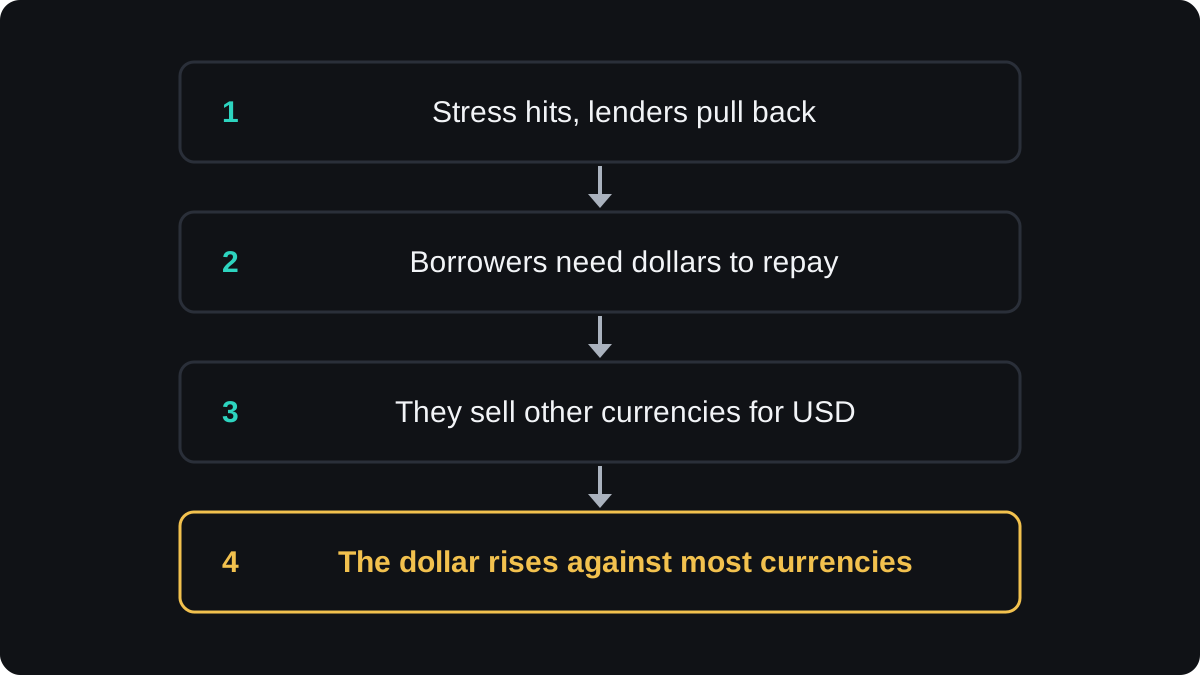
This can happen even when the trouble starts inside the United States. In late 2008 the US housing crash sat at the centre of the crisis, yet the dollar rose against most currencies.
It jumped again in March 2020, when the pandemic sent investors around the world scrambling for cash.
How does a dollar squeeze move exchange rates?
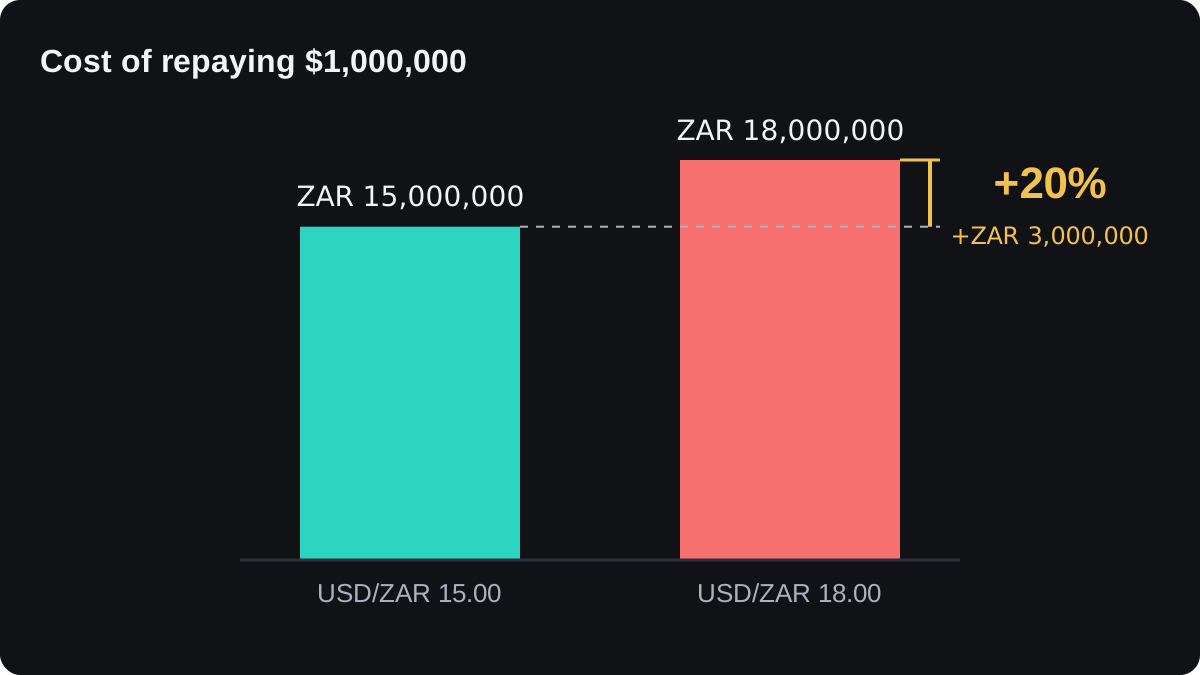
Take the firm with the one million dollar loan, and say it is South African. The rates below are round illustrative numbers, not a record of a real episode.
- Before the stress, USD/ZAR is 15.00, so one dollar costs 15 rand.
- Repaying $1,000,000 costs 1,000,000 × 15.00 = 15,000,000 rand.
- During the squeeze, USD/ZAR rises to 18.00.
- The same repayment now costs 1,000,000 × 18.00 = 18,000,000 rand.
- The extra cost is 3,000,000 rand, and 3,000,000 ÷ 15,000,000 = 20% more.
Measured the other way, one rand fell from 0.0667 dollars (1 ÷ 15) to 0.0556 dollars (1 ÷ 18), about 16.7% less. The two percentages differ because they start from different numbers.
A weaker currency makes dollar debt heavier, so more borrowers rush to buy dollars or hedge what they owe. That buying weakens the currency further, which is one reason squeeze moves can be large and fast.
The damage is uneven. Currencies of countries with large dollar debts, commodity exporters and many emerging markets have usually fallen hardest.
The Japanese yen and Swiss franc have often held up better, partly because investors from Japan and Switzerland tend to bring money home in stress. The risk-on and risk-off lesson covers that wider pattern.
How does the strain show in the swap market?
Many banks outside the US get dollars through an FX swap. A euro area bank hands over euros today, receives dollars, and agrees to swap back at a fixed rate in three months.
In calm markets, the price of that swap mostly reflects the gap between interest rates in the two currencies. Any extra cost on top of that gap is the cross-currency basis.
In stress, that extra cost grows, because far more banks want to be the side that receives dollars. Here is the arithmetic with illustrative numbers:
- The bank needs $100,000,000 for three months.
- In calm times the extra cost is small. To keep the sum simple, call it zero.
- In a squeeze the extra cost rises to 0.50% a year.
- For three months that is 100,000,000 × 0.0050 × 3 ÷ 12 = $125,000 of extra cost.
Retail traders do not trade the basis, but it appears in financial news and central bank research. A basis that widens sharply is one sign that dollar funding is getting tight.
How do central banks ease a dollar shortage?
The US Federal Reserve is the only central bank that can create US dollars. Through a swap line, it lends dollars to another central bank and takes that bank's currency in return, reversing the deal at the same rate later.
The other central bank then lends those dollars to its own banks. Borrowers who could not find dollars in the market can get them at home, so they stop dumping their own currency to buy them.
In 2008 and again in 2020 the Fed lent large amounts this way, and it opened temporary lines with extra central banks.
It also keeps standing lines with a small group of major central banks, among them the European Central Bank, the Bank of Japan and the Bank of England.
Once borrowers trust that dollars are available, the scramble tends to ease and the basis narrows. After March 2020 the dollar gave back much of its gain over the following months.
Swap lines are one tool among several, and the central banks lesson covers the rest.
What does a dollar squeeze mean for a trader?
Suppose you hold a long AUD/USD position of 0.50 lot when a squeeze hits. The Australian dollar is a commodity currency, and it has often fallen in these episodes.
The prices are illustrative:
- One lot is 100,000 AUD, so 0.50 lot is 50,000 AUD.
- You bought at 0.7000.
- You close as the pair reaches 0.6650: 0.7000 − 0.6650 = 0.0350, which is 350 pips.
- A pip is 0.0001 × 50,000 = $5 on this size.
- The loss is 350 × $5 = $1,750.
- A stop loss at 0.6900 would have limited it to 100 pips, or $500, if it filled at that price.
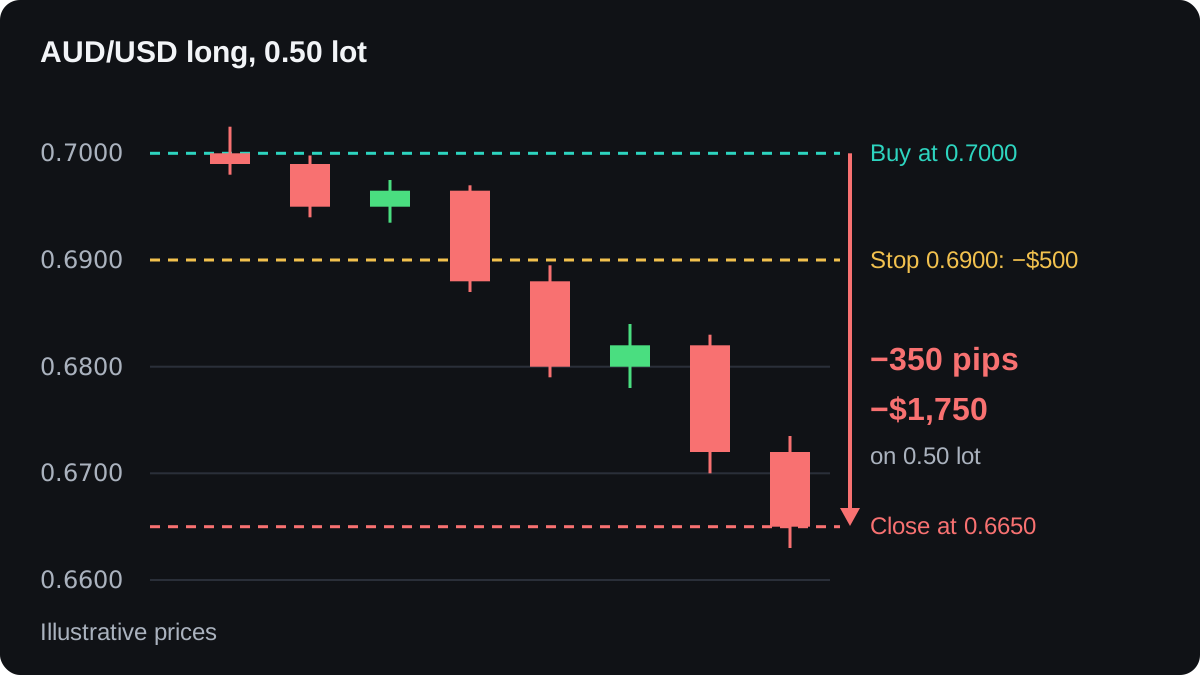
That condition matters, because spreads widen and prices can jump in stressed markets, so a stop can fill worse than its level.
Spare margin helps when moves are this large, as the margin buffer lesson explains. The pip value calculator redoes step 4 for other position sizes.
When the pattern fails
A dollar rise in a crisis is a tendency from past episodes, with exceptions. If the shock comes from US policy itself, or the Fed cuts rates fast and floods markets with dollars, the dollar can fall.
Size and timing vary as well. The squeeze phase can last days or months, and nobody can see in advance when central bank help will turn it. In some episodes, such as 2008, the yen rose against the dollar.
The US dollar index shows how broad a dollar move is. Stories about safe havens spread quickly once a move starts, and market narratives are the subject of the next lesson.
Questions
Why does the US dollar rise during a crisis?
Many borrowers outside the US owe dollars and need them to repay or roll loans. When lenders pull back, those borrowers sell their own currencies to buy dollars, and that demand often pushes the dollar up against most currencies.
What is a Fed swap line?
It is an agreement where the US Federal Reserve lends dollars to another central bank in exchange for that bank's currency, reversing the trade later. The other central bank then lends the dollars to its own banks.
Is the US dollar always a safe haven?
No. It has risen in several past crises, but a shock caused by US policy or fast Fed rate cuts can weaken it, and the yen or Swiss franc sometimes rise more.
What is the cross-currency basis?
It is the extra cost, beyond the normal interest-rate gap, of borrowing one currency by swapping another for it. When dollars are scarce, the extra cost of getting dollars this way rises.
How does dollar funding stress affect retail traders?
You feel it through price. Currencies such as the Australian dollar or emerging market currencies can fall fast against the dollar, spreads can widen and stops can fill worse than planned.