How is crypto different from forex?
Forex is the trade of national currencies, issued by central banks and traded around the clock on weekdays. Crypto is the trade of digital coins that mostly have no central issuer, and it trades at weekends too. Crypto prices usually swing much further in a day, and you can own the coin or trade a contract on its price.

Open a trading platform and the two look alike. EUR/USD shows a price such as 1.10000, BTC/USD a price such as 50,000.00, and each has the same buy and sell buttons.
Both are quoted as a currency pair: BTC/USD is the price of one bitcoin in US dollars, just as EUR/USD is the price of one euro. Underneath, the two markets work very differently.
What you are actually trading
In forex you trade the money of whole economies. A currency's value depends on interest rates, inflation, trade flows and the decisions of its central bank.
Most coins have no central bank behind them. A coin's price comes from demand for it, set against a supply that its software controls.
Supply shows the contrast best. The European Central Bank sets interest rates for the euro and can create new euros. Bitcoin's software caps its supply at 21 million coins, and no single body can change that cap.
Market hours: five days versus seven
Forex trades around the clock from about 5 pm New York time on Sunday to 5 pm on Friday. It passes from one trading session to the next as the business day moves around the world.
At the weekend the banks that make the market stop dealing, and prices wait for the next open.
Crypto exchanges have no weekly close. Bitcoin trades on Saturday night and on public holidays, because the network behind it runs all the time.
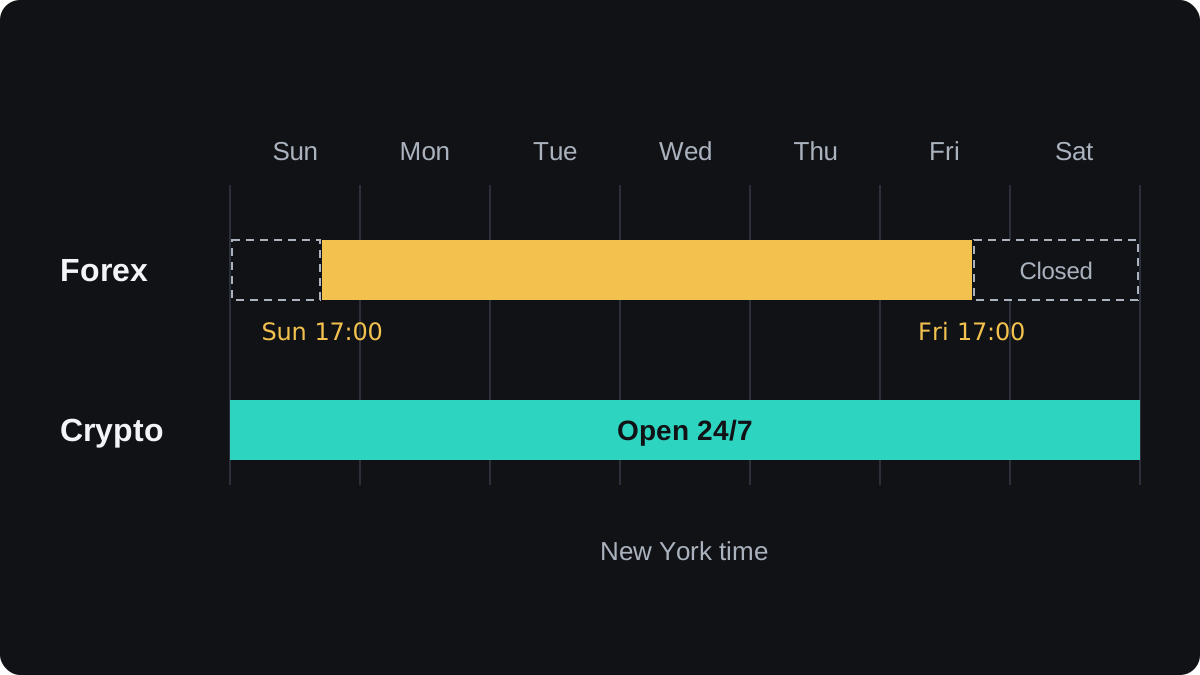
Weekend trading has a cost. Fewer traders are active, so prices can jump on thin volume. In forex, news from the weekend shows up instead as a gap between Friday's close and the next open.
Your broker's platform shows trading hours in its own server time, so check the hours of each instrument there. Some brokers pause crypto contracts for maintenance or treat weekends differently, as trading crypto CFDs at weekends explains.
How far prices move
Crypto prices usually move much further than currency prices. A 1% day is a big move for EUR/USD, while bitcoin can move 5% in a day with no special news.
Here is what that means for the same position size, with round illustrative moves:
- You hold a position worth $10,000 in EUR/USD. The pair moves 0.5% in a day, so your result changes by 10,000 × 0.005 = $50.
- You hold $10,000 of bitcoin. It moves 5% in a day, so your result changes by 10,000 × 0.05 = $500.
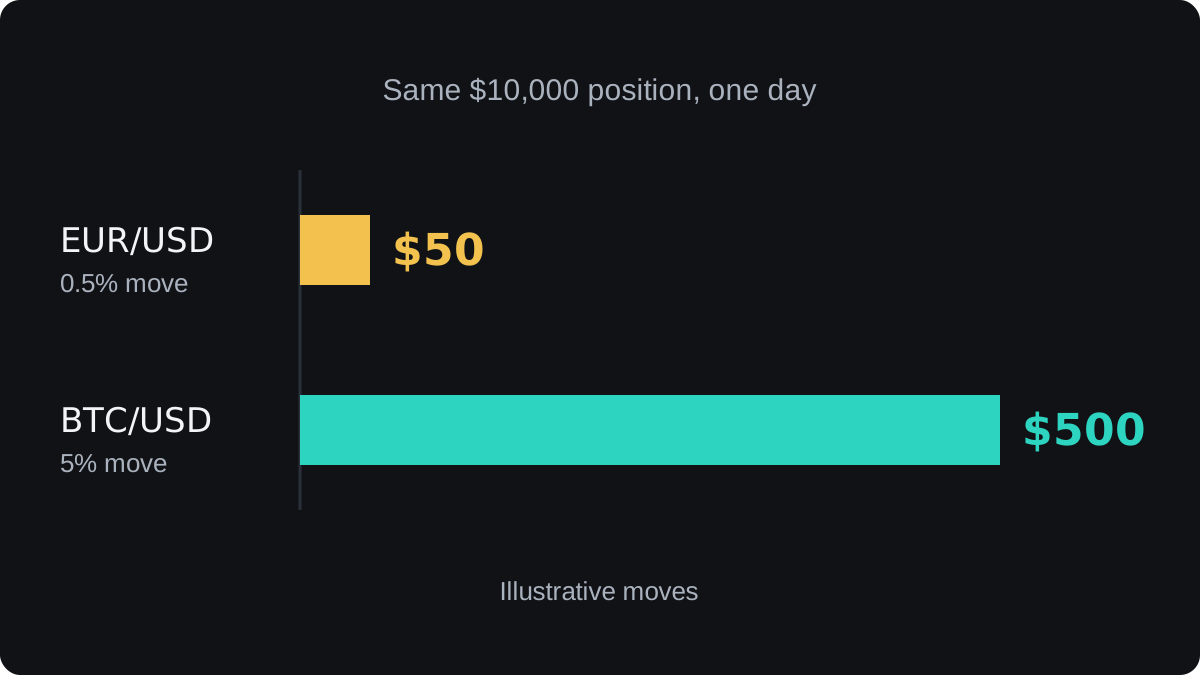
A position size that feels small in forex can be large in crypto.
That is also why brokers and regulators usually set lower leverage limits for crypto than for major currency pairs. Your broker's contract specification shows the limit for each instrument.
Where trading happens and who is on the other side
Forex is an over-the-counter market. Banks and dealers trade with each other directly, and retail traders reach the market through a broker.
Crypto trades on many separate exchanges, each with its own order book. Bitcoin can cost slightly more on one exchange than on another at the same moment. Decentralized exchanges run on blockchains, with no company matching the orders.
Regulation differs too. Forex brokers in most large markets need a licence under rules that have been in place for years. Crypto rules are newer and are still changing in many countries.
Whichever you trade, check which regulator licenses the firm and what that licence covers where you live.
Owning the coin or trading a contract
When you buy bitcoin on an exchange, you own coins. You can withdraw them to your own wallet or send them to someone else.
You can also trade crypto as a CFD, a contract for difference with a broker. You gain or lose from the price moves, and you never hold a coin or need a wallet.
Retail forex works this way at most brokers. You trade the price of EUR/USD, and no euros ever land in your account. The crypto CFD lesson explains how these contracts work.
Costs and how prices are quoted
The costs look different in each case:
| Forex at a broker | Crypto on an exchange | Crypto CFD at a broker | |
|---|---|---|---|
| Main trading cost | Spread, sometimes a commission per lot | Trading fee as a percentage | Spread, sometimes a commission |
| Holding overnight | Swap, a cost or a credit | Usually no fee for holding coins | Often an overnight fee (swap) |
| Moving funds | Deposit and withdrawal fees, if any | Network fee to withdraw coins | Deposit and withdrawal fees, if any |
| Price step | Pip, 0.0001 on most pairs | Tick size set by the exchange | Tick size set by the broker |
Exchange fees are usually split into maker and taker fees, covered in maker and taker fees. As an illustration, a 0.1% fee on a $10,000 trade is $10, so buying and later selling costs about $20 before any spread.
There is no shared pip for crypto. Check the tick size and contract size in the broker's or exchange's specification before you work out a profit or loss.
Questions
Is crypto riskier than forex?
Crypto prices swing more, and holding coins adds risks such as hacked exchanges and lost keys. Forex with high leverage can lose money just as fast, so your position size matters as much as the market.
Can you trade crypto with a forex broker?
Many forex brokers offer crypto CFDs on the same platform as currency pairs. You trade the price only, so you cannot withdraw coins, and the hours, fees and leverage depend on the broker.
Why does crypto trade at weekends when forex does not?
Forex depends on banks dealing with each other, and banks do not deal at weekends. A crypto network runs on computers that never stop, so exchanges keep matching orders every day.
Do pips exist in crypto?
There is no standard pip for crypto. Traders count moves in dollars or in percent, and each venue sets its own tick size. Some brokers use the word pip for crypto with their own definition, so read the contract specification.
Keep learning
 Chapter 1What is cryptocurrency?Cryptocurrency is digital money recorded on a shared public ledger called a blockchain. A network of computers checks every transfer, and no central bank issues the coins. You control your coins with a secret private key, and the price is whatever buyers and sellers agree to trade at.
 Chapter 1Is crypto an asset class of its own?Crypto has its own markets and its own price drivers, two marks of an asset class. It differs from stocks and bonds in one basic way: most coins pay no income, so their price rests on demand alone. Some funds and investors now give it a separate slot, and whether that lasts is still debated.

