What is on-chain cost basis?
On-chain cost basis estimates what holders paid by valuing each coin at the price on the day it last moved on the blockchain. Add those values up and divide by the supply, and you get the realized price, the average cost of the whole market. Split by coin age, it gives a separate cost for short-term and long-term holders.

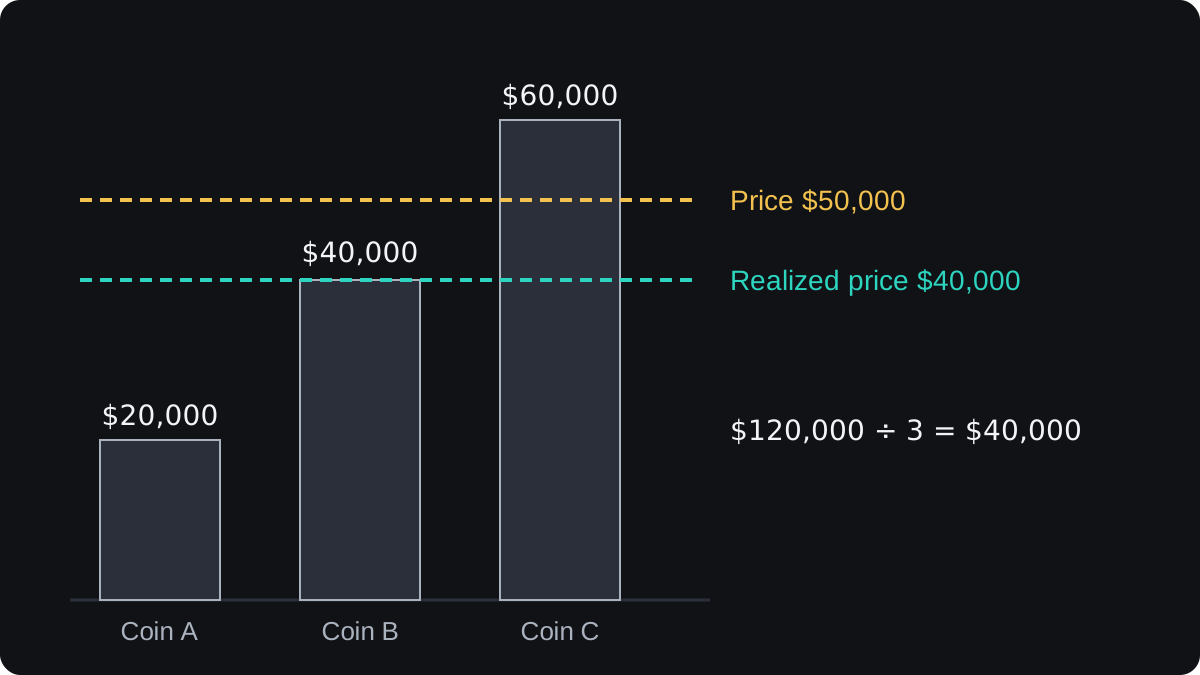
Imagine a tiny illustrative market with only three coins. The first last moved on the blockchain when the price was $20,000, the second at $40,000 and the third at $60,000. Today the price is $50,000.
Two of the three holders are in profit and one is at a loss. On-chain cost basis is a way to measure the same thing across millions of coins.
Cost basis from the blockchain
In accounting, cost basis is what you paid for an asset. A blockchain does not know what anyone paid. It does know when each coin last moved, and a data provider knows the market price at that moment.
On-chain cost basis values each coin at the price on the day it last moved and treats that as the holder's entry price.
On Bitcoin, the units are unspent transaction outputs, the pieces of coin that a Bitcoin transaction creates and a later one spends.
When a coin moves, its recorded price resets to the price at that moment. A coin bought years ago and never moved keeps its old, low price.
Realized cap and realized price
Add up every coin's value at its last-moved price and you get the realized cap, also called realized value.
Divide it by the number of coins in circulation and you get the realized price, the average on-chain cost basis of the whole market.
Worked example
Using the three illustrative coins:
- Realized cap = $20,000 + $40,000 + $60,000 = $120,000.
- Realized price = $120,000 ÷ 3 coins = $40,000.
- Market cap = 3 coins × $50,000 = $150,000.
- Price compared with realized price: $50,000 ÷ $40,000 = 1.25, so the market trades 25% above the average holder's cost.
Realized cap moves slowly. Market cap changes with every price tick, while realized cap changes only when coins actually move and get repriced.
Short-term and long-term holders
Providers often split the supply by how long coins have sat still. Coins that moved recently belong to short-term holders, and coins that have not moved for a set time belong to long-term holders.
A common cut-off is about 155 days, after which coins become unlikely to move. Check how each provider defines it. Each group gets its own realized price.
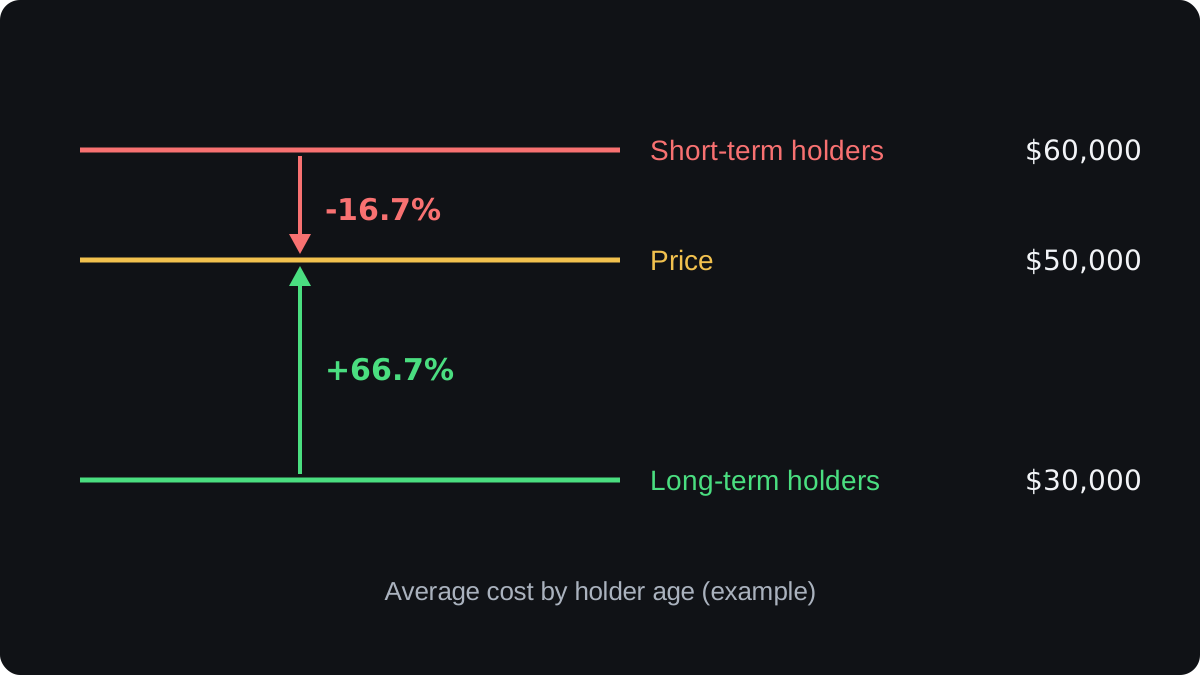
In the example, say only the $60,000 coin moved recently. The short-term holder realized price is $60,000. The long-term holder realized price is ($20,000 + $40,000) ÷ 2 = $30,000.
At a price of $50,000, recent buyers are 16.7% below their cost on average, because 50,000 ÷ 60,000 = 0.833. Long-term holders are 66.7% above theirs, because 50,000 ÷ 30,000 = 1.667.
How traders read cost basis
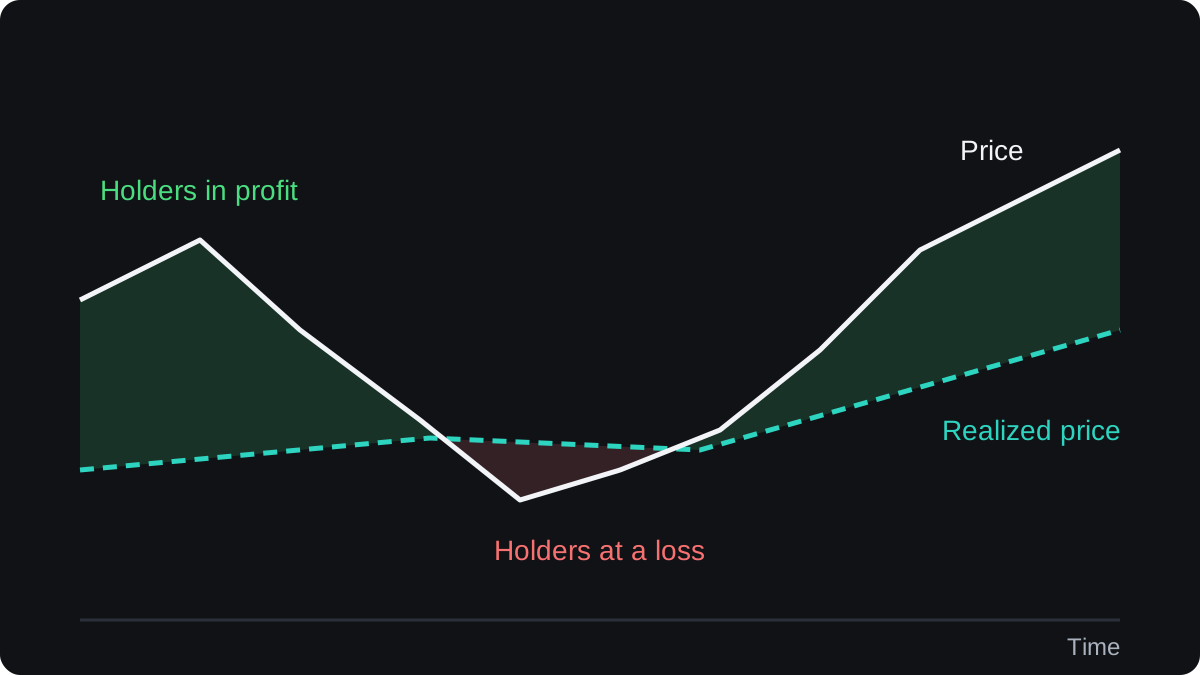
The realized price is a rough line between an average holder in profit and an average holder at a loss. When price trades below it, the market as a whole holds coins worth less than their on-chain cost.
The line drifts toward price. Coins that move at a price above their old cost lift it, and coins that move at a loss pull it down.
As a result, it tends to rise while price is above it and to stall or slip lower while price is below.
The short-term holder realized price gets the most attention in trends, because recent buyers react fastest to price.
When price climbs back to their average cost from below, many recent buyers are back to breakeven, and some sell to get out. That selling can slow a rally right at the level.
These levels are therefore areas to watch, a little like support and resistance on a chart. Price can cut straight through them, and often does in fast markets.
Where cost basis misleads
The last-moved price is not a purchase price. Someone who moves coins between two of their own wallets resets the cost basis without buying anything. Providers try to filter these moves with address clustering and their own wallet labels, with mixed success.
Buying on a centralised exchange leaves no trace on the chain, as the on-chain analysis lesson explains. Coins in an exchange wallet carry the price from when they arrived, whoever has traded them since.
Lost coins still count. Coins whose keys are gone keep the price at which they last moved, which for bitcoin lost in the early years was close to zero, so they pull the realized price down.
Account-based chains such as Ethereum keep one balance per address instead of separate coin pieces, so providers estimate cost basis with their own methods. Two providers can show different realized prices for the same coin.
Cost basis gives context for market cycles. On its own, it does not tell you when to enter or exit a trade.
Questions
What is the realized price of Bitcoin?
It is Bitcoin's realized cap divided by its circulating supply, an estimate of the average price at which all bitcoins last moved. It changes every day, so read it from a current data source.
Is realized price the same as the average purchase price?
It is close, but it differs. It uses the price when coins last moved on the blockchain, which misses trades inside exchanges and counts moves between a person's own wallets.
What is the short-term holder cost basis?
It is the realized price of coins that moved recently, often within about 155 days. It estimates what recent buyers paid on average.
Why does realized cap change more slowly than market cap?
Market cap reprices every coin at the latest price. Realized cap reprices a coin only when it moves on-chain, so most of the supply keeps its old value from day to day.
Keep learning
 Chapter 2What is on-chain analysis?On-chain analysis is the study of a blockchain's public records, such as transfers, balances and the age of coins, to see how holders behave. Data providers turn raw transactions into metrics like exchange flows and realized price. It adds context about supply and holder profit, but it cannot tell you when to trade.
 Chapter 2Spot volume and volume delta.Spot volume is the amount of a coin traded for immediate delivery over a period. Volume delta splits that volume by who started each trade: volume from market buy orders minus volume from market sell orders. A positive delta means buyers were the more aggressive side, which is different from saying there were more buyers.
 Chapter 2Exchange flows and exchange balances.Exchange flows track coins moving onto and off known exchange addresses. Inflows arrive, outflows leave, and netflow is inflow minus outflow. Exchange balance is the total held at those addresses, often shown as a share of supply. Rising balances can mean coins ready to sell, but every figure depends on how well a provider labels exchange wallets.
 Chapter 2What is SOPR?SOPR, the spent output profit ratio, compares what coins were worth when spent on-chain with what they were worth when last received. Above 1 means the coins that moved were spent at a profit on average; below 1 means at a loss. Traders watch how SOPR behaves around 1 to see whether holders are taking profits or giving up.
 Chapter 2What is NUPL?NUPL, net unrealized profit and loss, measures how much paper profit or loss all holders of a coin are sitting on, as a share of market cap. It equals market cap minus realized cap, divided by market cap. A positive reading means holders are in profit overall; a negative one means the market trades below its on-chain cost basis.
 Chapter 2What is MVRV, and how do traders read it?MVRV, market value to realized value, divides a coin's market cap by its realized cap, which values each coin at the price when it last moved. A reading of 1.25 means holders are up 25% on average, and below 1 means they are at a loss. Traders use MVRV and its holder-age versions to judge how stretched valuations are.
 Chapter 2What is the MVRV Z-score?The MVRV Z-score measures how far a coin's market cap sits above or below its realized cap, in units of the standard deviation of market cap over its history. The formula is market cap minus realized cap, divided by that standard deviation. High readings mean an unusually stretched market; readings below 0 mean price is under the average on-chain cost.

