What does the Bitcoin network do?
The Bitcoin network checks every payment against shared rules, puts valid payments in order inside a new block about every 10 minutes, adjusts how hard mining is so that pace holds, and releases new bitcoin on a fixed, shrinking schedule. No company runs it, and it does not set the price, know who you are or reverse payments.
Bitcoin has no head office and no staff who approve payments. Even so, roughly every ten minutes a new batch of payments is checked, put in order and added to a record kept by computers around the world.
That work is done by the Bitcoin network: thousands of nodes running compatible software, plus miners who compete to add blocks. It has a short list of jobs and does each one by strict rules.
Job 1: check every payment
A Bitcoin payment is a signed message saying which coins move and where they go. Each node checks it before passing it on.
The node asks whether the coins being spent exist and have not been spent already. It checks that the digital signature proves the sender controls them, and that the payment does not send out more than it takes in.
A payment that fails any check is dropped, no matter who sent it or how large it is. The details are in how a Bitcoin transaction works.
Job 2: put payments in order
Checking alone cannot stop someone from signing two payments that spend the same coins. The network also has to agree which one came first.
Valid payments wait in each node's mempool. Miners pick payments from it, usually the ones paying the highest fee for the space they take, and pack them into a candidate block.
To add that block, a miner must find a number that gives the block a hash below a target. That takes an enormous number of guesses, which is the proof of work. How Bitcoin mining works explains the puzzle.
When a miner finds one, it sends the block out. Every node checks it, adds it to its copy and removes the included payments from its mempool.
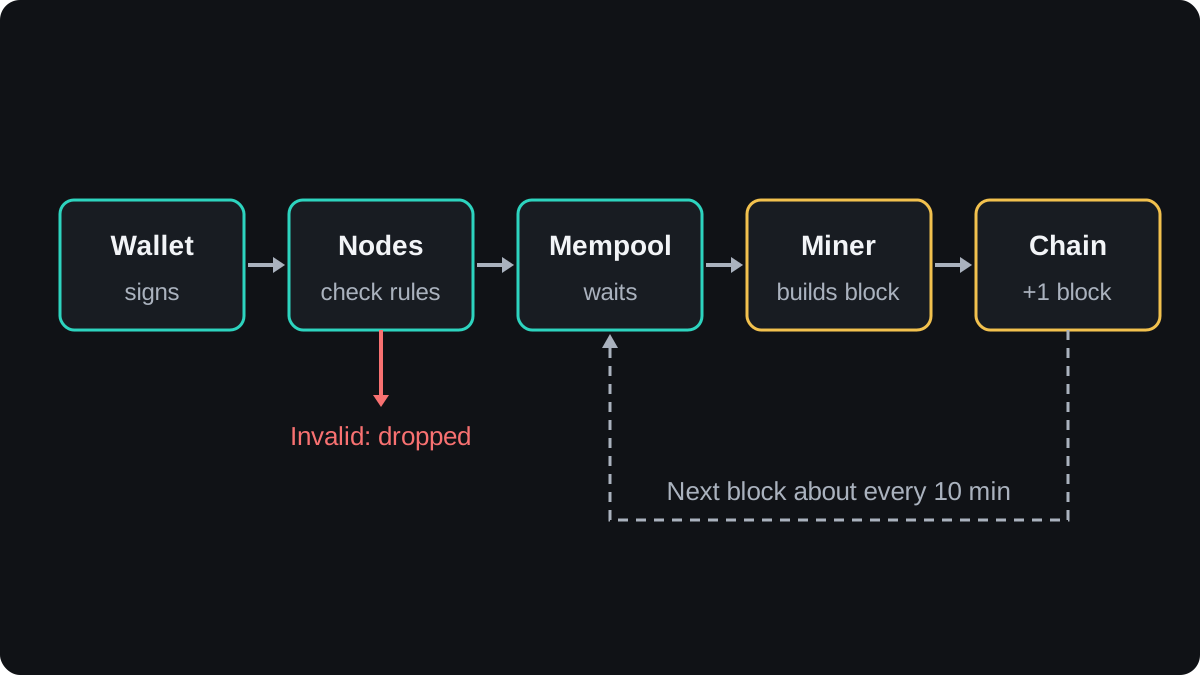
Job 3: keep blocks coming about every 10 minutes
If more mining machines join, blocks start coming faster. If machines leave, they come slower. The network corrects for this by changing the difficulty, which sets how hard the puzzle is.
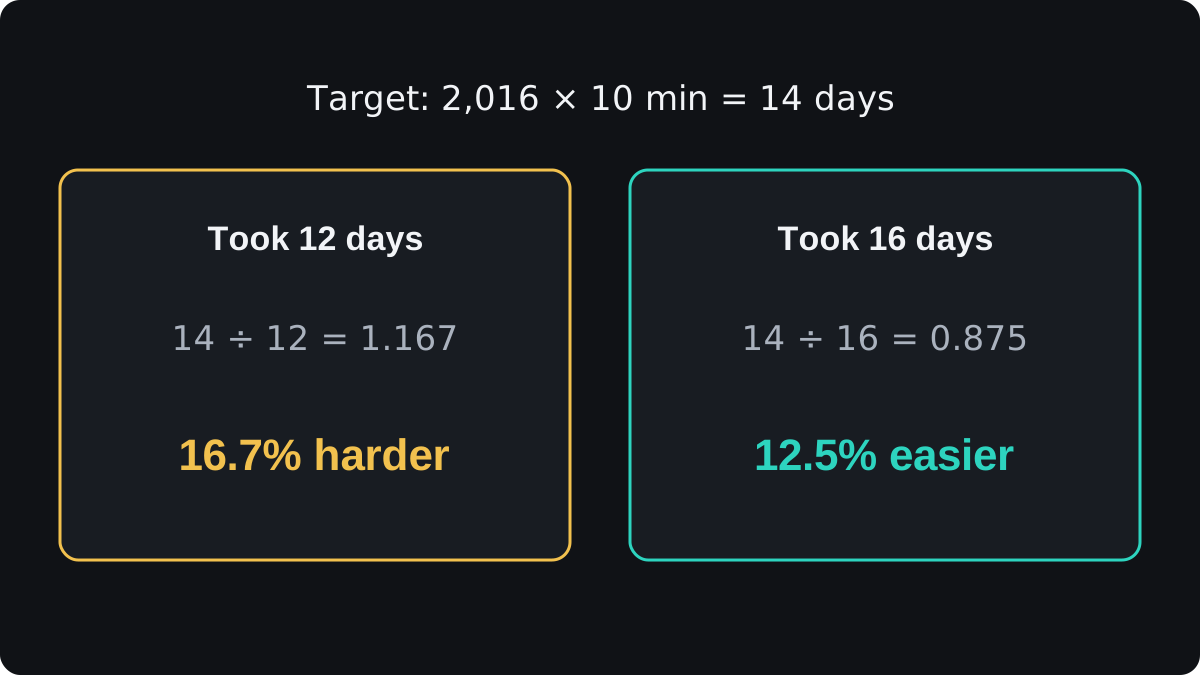
Every 2,016 blocks, each node compares how long those blocks actually took with the target time. The target is 2,016 × 10 minutes = 20,160 minutes, which is exactly 14 days.
Here is a worked example with round numbers, for illustration:
- Miners add machines, and the last 2,016 blocks take 12 days.
- The network multiplies difficulty by 14 ÷ 12 = 1.167, so mining becomes about 16.7% harder.
- Later, miners switch machines off, and the next 2,016 blocks take 16 days.
- Difficulty is multiplied by 14 ÷ 16 = 0.875, so mining becomes 12.5% easier.
Nobody votes on this. Every node runs the same formula on the same blocks and reaches the same answer.
Job 4: issue new bitcoin on a fixed schedule
The miner who adds a block may pay itself newly created bitcoin, called the block subsidy, plus the fees of the payments inside. This is the only way new bitcoin comes into existence.
The subsidy started at 50 BTC per block and halves every 210,000 blocks. At 10 minutes per block, that is 210,000 × 10 = 2,100,000 minutes, or about 4 years. The fourth halving, in 2024, cut it to 3.125 BTC.
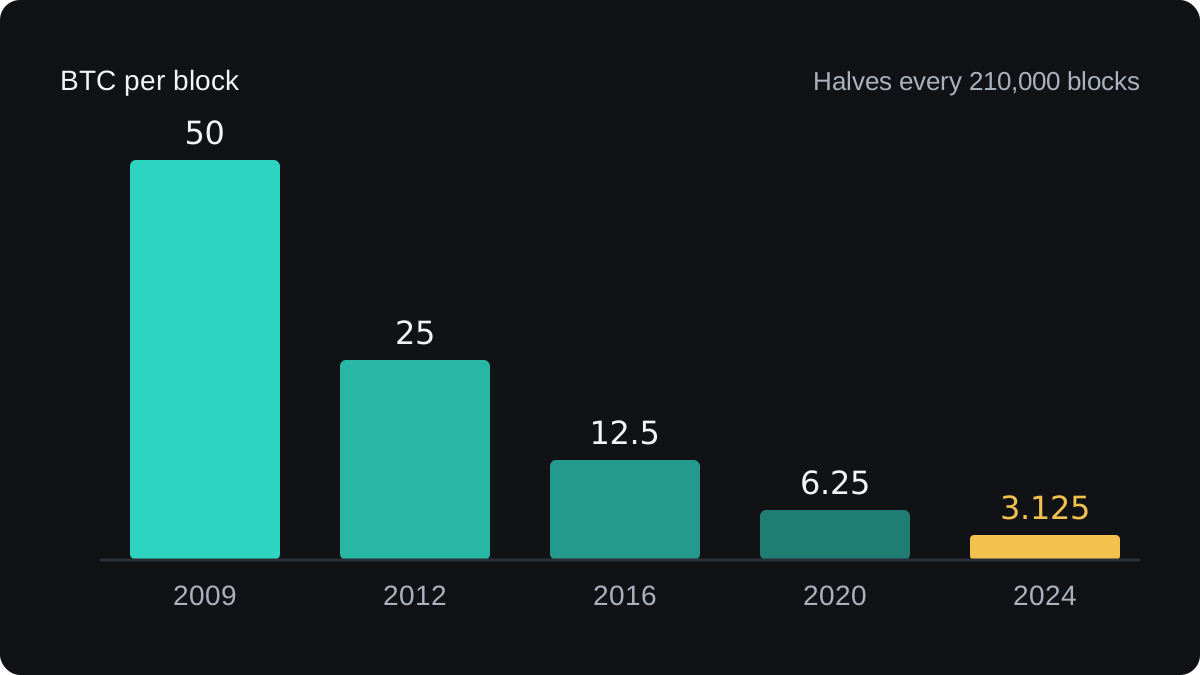
The halvings set the supply limit. The first 210,000 blocks created 210,000 × 50 = 10,500,000 BTC, and each later stage adds half as much as the one before.
Added up, the stages get closer and closer to 2 × 10,500,000 = 21,000,000 BTC without ever reaching it. The halving lesson covers what each cut means for miners.
Job 5: let anyone check the whole history
Anyone can download the full chain, from the first block in January 2009, and check every payment since. Nobody needs permission, and every honest copy gives the same answer.
This is why some people run their own node. They can see their balance without trusting anyone else's report of it.
What the Bitcoin network does not do
Some things people expect from a payment system are missing on purpose.
- It does not know or set the price. Prices come from trades on crypto exchanges and other markets.
- It does not know who you are. It records addresses and signatures and has no field for names.
- It cannot reverse a payment. There is no chargeback and no support line.
- It does not hold your coins in an account. Your coins are entries on the chain, and your keys control them.
A Bitcoin CFD sits outside the network entirely. If you trade one with a broker, the contract lives in the broker's records and no bitcoin moves on the chain. What is a crypto CFD explains how that works.
Questions
Who controls the Bitcoin network?
No single party. Developers propose software, miners choose which payments to put in blocks, and node operators decide which rules their own software enforces, so any change needs wide agreement.
How long does a Bitcoin transaction take?
It reaches most nodes within seconds. With a high enough fee, it goes into one of the next blocks, which arrive about every 10 minutes on average. Many services wait for a few more blocks before treating it as final.
What happens when all 21 million bitcoin are mined?
Strictly, the total stops a little under 21 million. The subsidy keeps halving until it rounds down to zero, expected around the year 2140, and after that miners would be paid by transaction fees alone.
Does the Bitcoin network set the price of bitcoin?
No. The network records ownership and transfers. The price is set by buyers and sellers trading on exchanges.
Keep learning
 Chapter 2What is a blockchain network?A blockchain network is the group of computers that run the same software, follow the same rules and keep the same copy of a blockchain. They pass transactions and blocks to each other directly, with no central server. Each network is separate, so coins sent on one network do not appear on another.
 Chapter 2What is a node?A node is a computer that runs a blockchain's software and is connected to its network. A full node keeps its own copy of the chain, checks every new transaction and block against the rules, and passes valid ones to other nodes. Wallets ask nodes for balances, and miners and validators are nodes with an extra job.

