Where do forex rebates come from?
A forex rebate comes from the introducing commission a broker pays the partner who referred your account. That commission is funded by the spread and fees you already pay. The partner passes part or all of it back to you, so you pay nothing extra and your trading conditions stay as they are.
If someone offers to pay you for trading, the first question should be where that money comes from. With a forex rebate the answer is short: from the broker, out of the revenue it already earns on your trades.
This lesson follows one lot from the moment you pay the spread to the moment part of it lands back in your account. If you have not read it yet, start with what a forex rebate is.
The three parties behind every rebate
The broker holds your trading account, quotes the prices and earns from your trading. It sets the spread and any commission for each account type.
The introducing broker (IB) is a partner that refers clients to the broker. It does not hold your account or your money. The broker pays it an introducing commission for every lot its clients trade.
You open the account through the IB's link or partner code, then trade as normal. The partner code is simply a tag on the account that tells the broker who introduced you.
How the money moves, step by step
- You open a trade and pay the spread, plus a commission per lot on accounts that charge one.
- You close the trade, and the broker records the volume.
- The broker sets aside the IB commission for that volume, following its partner schedule.
- The IB returns its agreed share of that commission to you as a rebate.
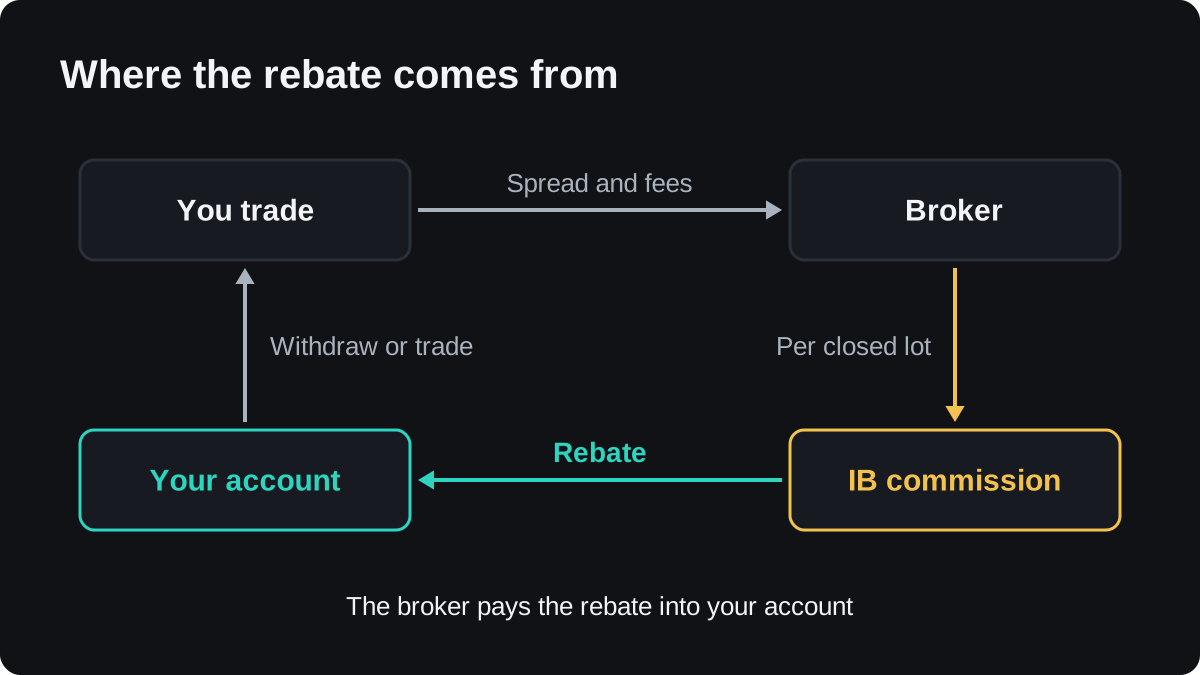
How step 4 happens varies between services. With AutoFXRebate, the broker pays the rebate straight into the account you trade from. Some services pay into a wallet of their own, which adds one more party to trust.
A worked example with real numbers
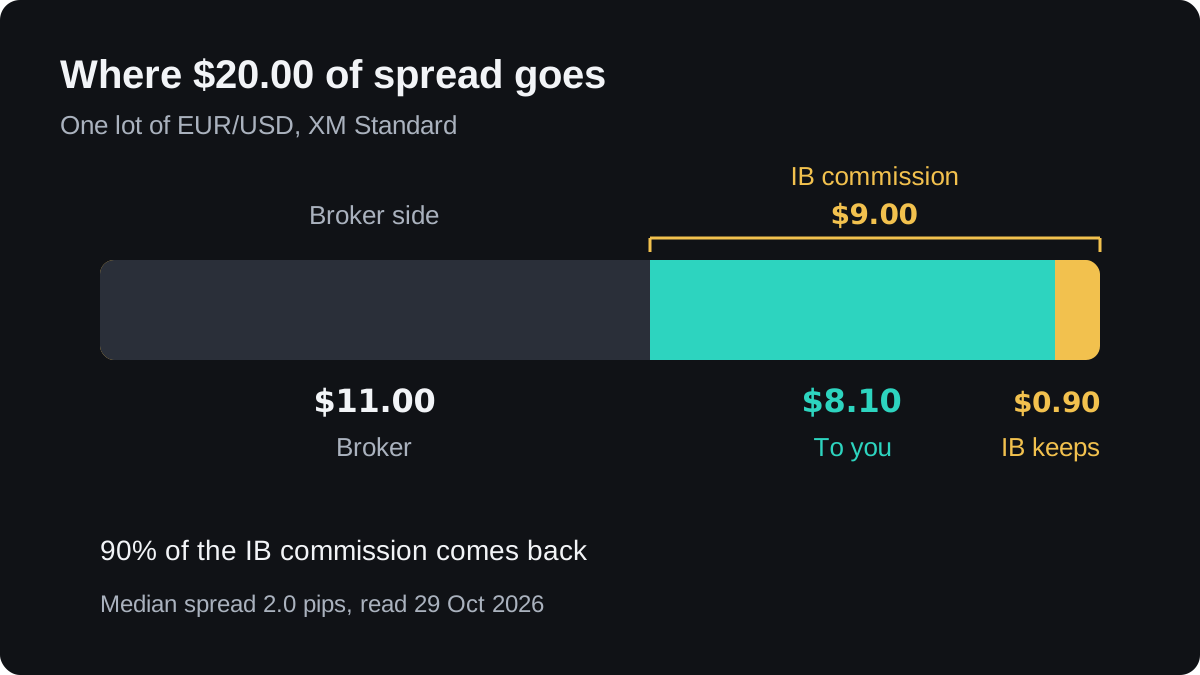
Take one standard lot of EUR/USD on the XM Standard account. The figures were read on 29 October 2026: the 24 hour median spread from the data behind the Spread Checker, the rebate from the XM rebate page.
- Spread cost. The median spread was 2.0 pips. One pip on a standard lot of EUR/USD is worth $10, so the lot cost 2.0 × $10 = $20.00. XM Standard charges no commission.
- What reaches you. The XM page lists $8.10 per lot on EUR/USD for this account. That figure is already the trader's share, which at XM is 90% of the IB commission.
- The full IB commission. If $8.10 is 90%, the whole commission is $8.10 ÷ 0.90 = $9.00. The IB keeps the other $0.90.
- The broker's side. Of the $20.00 you paid, $20.00 − $9.00 = $11.00 stays on the broker's side.
On the Exness rebate page, the rate for the Standard account is a share of the spread rather than a dollar figure: 40% of it. With AutoFXRebate you receive 100% of that commission, paid by the broker, so the IB keeps nothing.
On the same date the median EUR/USD spread on Exness Standard was 0.8 pips, or $8.00 per lot. Forty percent of $8.00 is $3.20, which is what came back.
These are measured and published figures for one day. Spreads move all the time and partner schedules change, so treat the example as a method, not a promise.
Why you do not pay anything extra
The spread is set by the broker for each account type. Two traders on the same account type see the same price whether one of them came through an IB or not.
The IB commission is paid out of what the broker already earns. When no partner is attached to an account, that money is not paid to anyone; it simply stays with the broker.
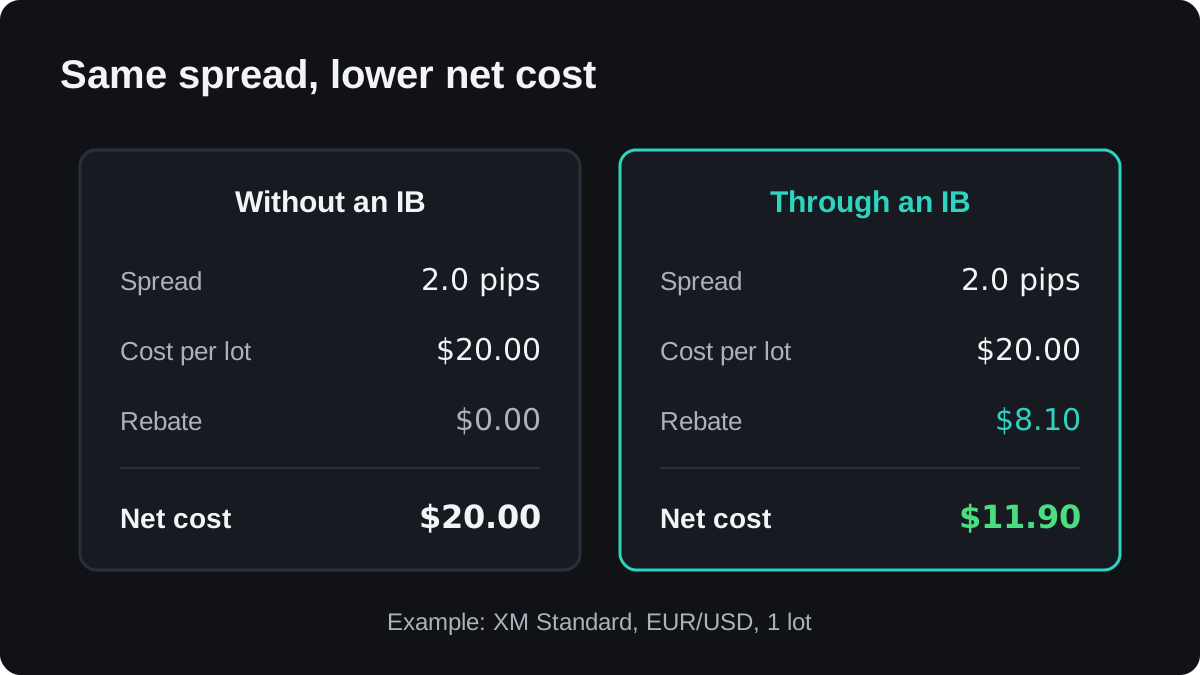
So the choice is not between paying more and paying less to the broker. You pay the same either way. The only question is whether part of it comes back to you.
Why brokers pay partners at all
Finding new clients costs a broker money, through advertising, sponsorships and sales teams. Paying a partner per lot traded is a way of buying clients where the cost only arises when the client actually trades.
That is also why rebates are per lot. The broker pays its partners on volume, so a partner that passes the money on can only pass it on per lot too.
Where the arrangement can go wrong
All of this assumes the IB uses the broker's normal account types. Some IB programmes elsewhere let a partner add a markup to the spread. Your trades then cost more, and part of the "rebate" is your own money.
The fix is to compare. Check that the spread on your account matches what the broker quotes for that account type, for example on the Spread Checker. The red flags lesson lists other warning signs.
Questions
Does my broker charge me more if I trade through an IB?
At Exness and XM, no. Spread, commission, leverage and execution are set per account type, and the partner attached to the account does not change them.
What is an introducing broker?
An introducing broker is a partner that refers clients to a broker and is paid a commission on their trading volume. It does not hold your account or your money.
How much of the IB commission comes back to me?
That depends on the IB. With AutoFXRebate you receive 100% of its IB commission at Exness and 90% at XM, paid by the broker straight into your trading account.
Can I get the IB commission without an IB?
Not through this route. The introducing commission is only paid when a partner is attached to the account; without one, that money stays with the broker.
Keep learning
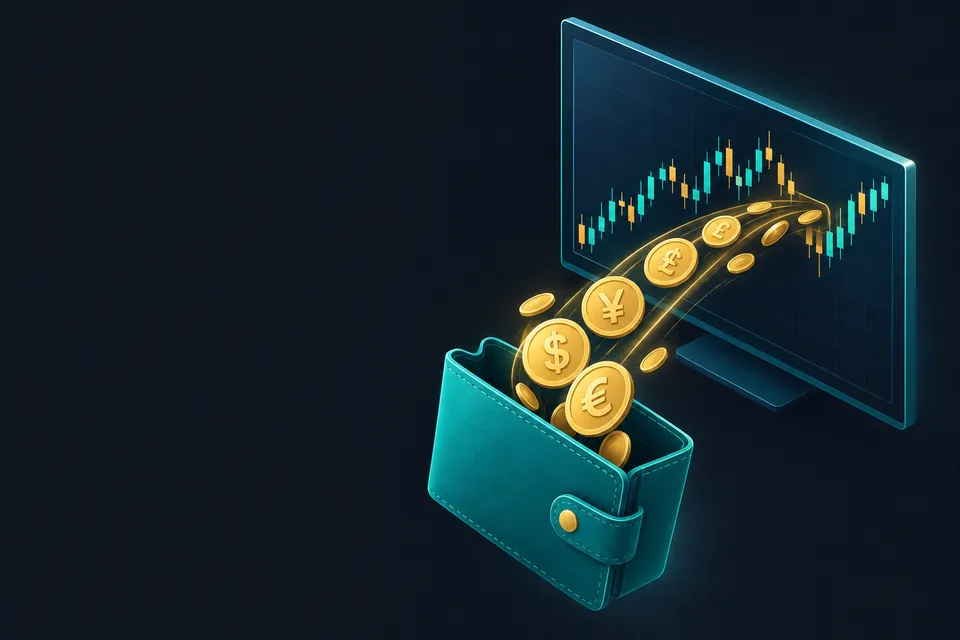 Chapter 1What is a forex rebate?A forex rebate is money paid back to you for every lot you trade. It comes from the commission a broker pays the partner who introduced your account, and that partner passes some or all of it back. You trade the same way at the same spread, and the cash arrives per closed lot.
 Chapter 1Rebate vs bonus: what is the difference?A rebate is cash returned for every lot you trade, paid into your balance and withdrawable like any other money. A deposit bonus is usually trading credit sized to your deposit, often with a volume target before any of it can be withdrawn, and it can be removed when you take money out.
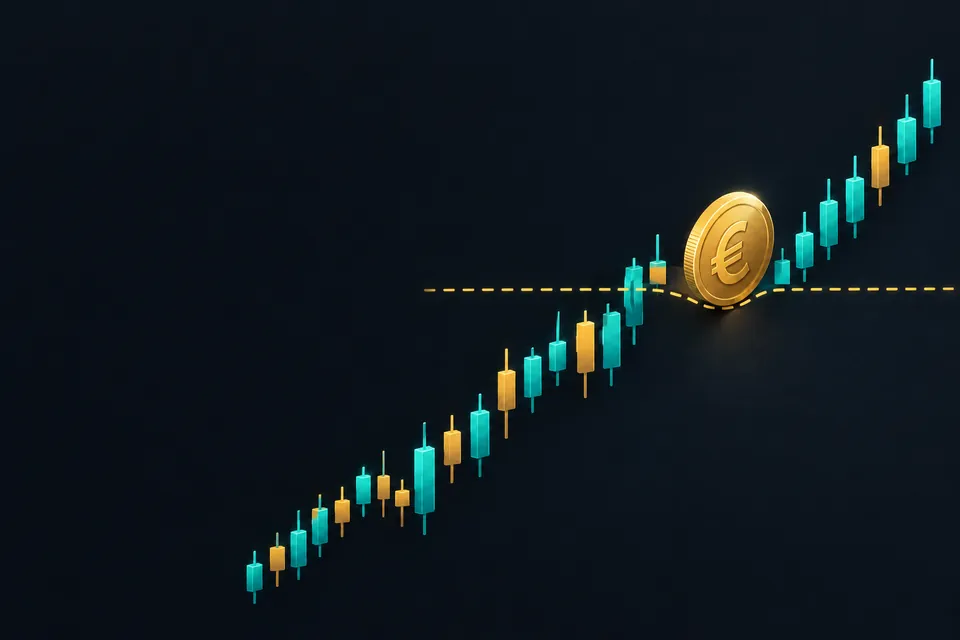 Chapter 1How does a rebate lower your breakeven point?Every trade starts slightly behind, because you pay the spread and any commission the moment you open it. A rebate returns part of that cost per lot, so the net cost is smaller and price needs to travel fewer pips before the trade pays for itself. Here is how to work it out with real rates.
 Chapter 1How do you move a forex account to a new IB?Moving an account to a new introducing broker changes one thing: the partner the broker pays commission to. Your balance, open positions, spread and leverage stay where they are. Brokers usually offer two routes, a partner change on the existing account or a new account opened under the new partner.
 Chapter 1What are the red flags of a forex rebate service?A sound rebate service only needs your account number to track volume, and the broker pays the rebate into your trading account. Warning signs are requests for your trading password, offers to hold your money, rates with no stated source, slow or unexplained payouts, and pressure to deposit through a private wallet.
 Chapter 1Forex rebates cheat sheet.A forex rebate returns part of the commission your broker pays the introducing partner, per lot you trade. It lowers your net cost and your breakeven distance without changing your spread. This page sums up the chapter: the key formulas, real rates read on 29 October 2026, the switching steps and the warning signs.

