How does a rebate lower your breakeven point?
Every trade starts slightly behind, because you pay the spread and any commission the moment you open it. A rebate returns part of that cost per lot, so the net cost is smaller and price needs to travel fewer pips before the trade pays for itself. Here is how to work it out with real rates.
Open a trade and look at the profit column. It is negative straight away, even before price moves. That gap is the spread, plus commission on some accounts, and the trade must earn it back first.
A rebate does not stop that gap from showing on screen. It shrinks what the trade really costs you once the rebate arrives. This lesson shows how to measure the difference in pips and in dollars.
Why every trade starts behind
When you buy, you pay the ask. When you close, you sell at the bid. The gap between them is the spread, paid once per round trip. Accounts with a commission per lot add that on top.
Together these make the cost of one trade. Your breakeven point is how far price has to move in your favour to cover that cost, before swap and slippage.
The breakeven formula with a rebate
Work per lot, in your account currency:
- Net cost per lot = spread cost + commission − rebate
- Breakeven distance = net cost per lot ÷ value of one pip per lot
Two things to keep in mind. The rebate is paid after the trade closes, so your platform still shows the full cost while the trade is open. And the formula covers trading costs only, not swap on positions held overnight.
Example 1: EUR/USD on a no-commission account
All figures read on 29 October 2026. The spread is the 24 hour median for XM Standard from the data behind the Spread Checker. The rebate comes from the XM rebate page.
- Spread cost. The median spread was 2.0 pips, and one pip on a standard lot of EUR/USD is worth $10. Cost: 2.0 × $10 = $20.00.
- Commission. XM Standard charges none: $0.00.
- Rebate. $8.10 per lot on EUR/USD.
- Net cost. $20.00 + $0.00 − $8.10 = $11.90 per lot.
- Breakeven distance. $11.90 ÷ $10 per pip = 1.19 pips, instead of 2.0 pips.
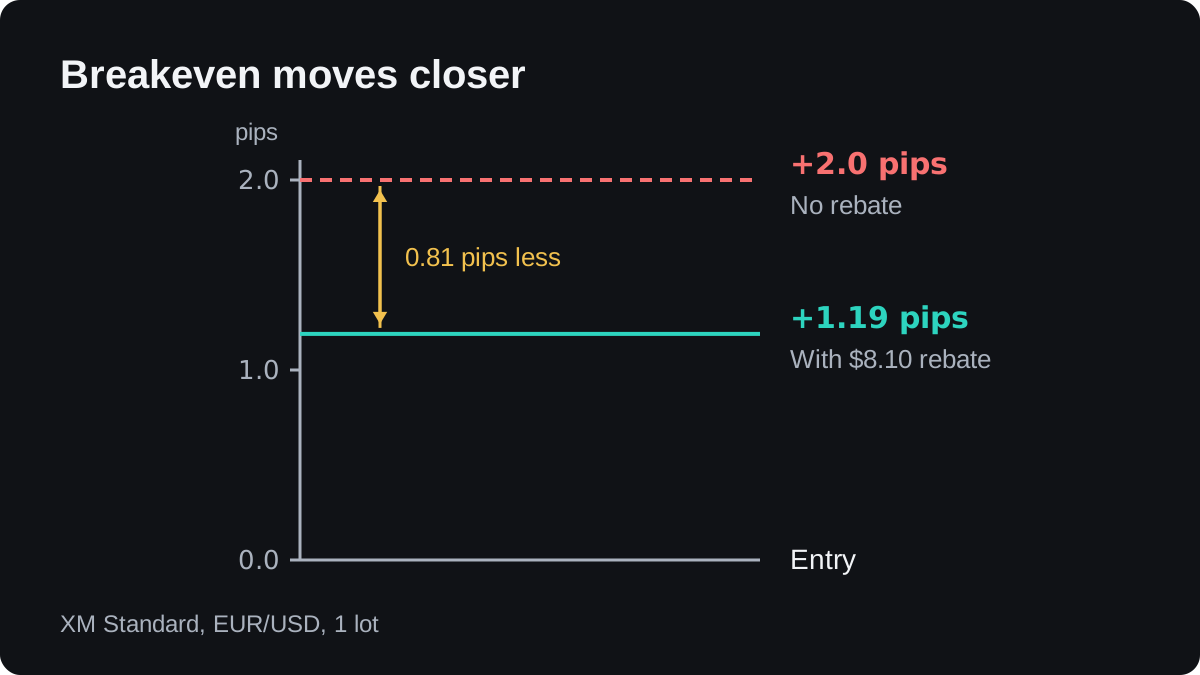
In other words, the rebate pays for $8.10 ÷ $20.00 = 40.5% of the cost of each lot. The trade still needs to move your way. It just needs to move 0.81 pips less.
What that means over a month
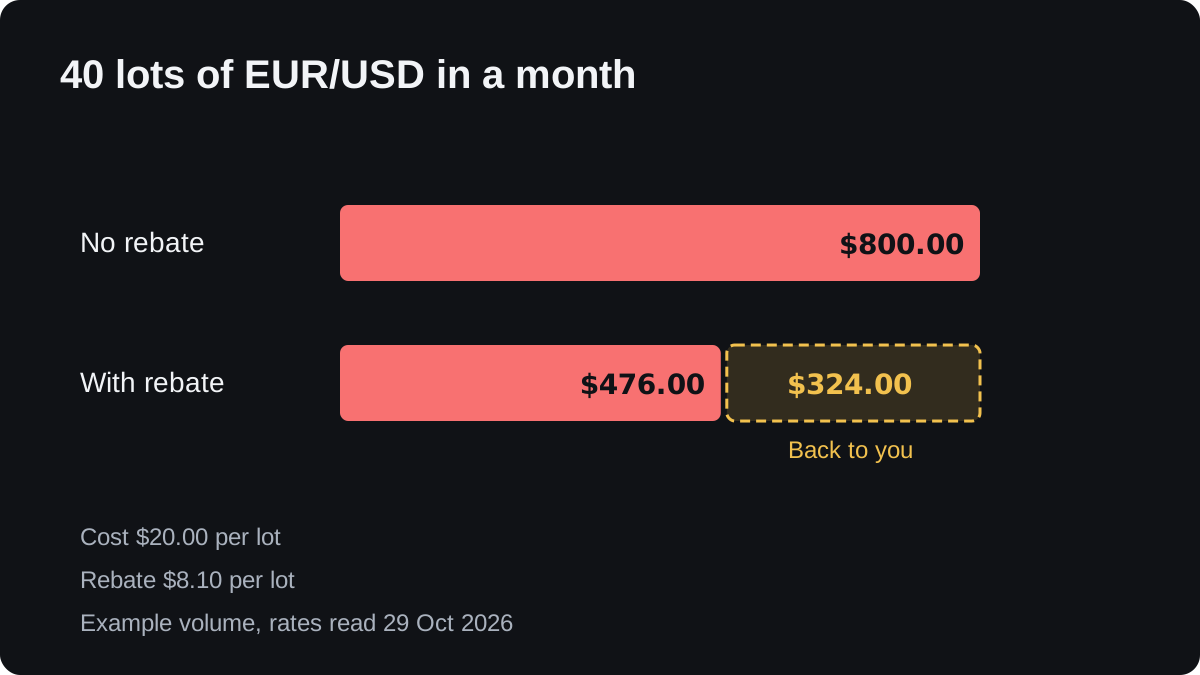
One lot is small change. Volume is where it shows. Say you trade 40 lots of EUR/USD in a month on that account, an example volume rather than a typical one.
- Cost before rebates: 40 × $20.00 = $800.00
- Rebates: 40 × $8.10 = $324.00
- Net cost: $800.00 − $324.00 = $476.00, which is also 40 × $11.90
For short-term trades the share is what matters. If you aim for 5 pips per trade, a 2.0 pip cost eats 40% of the target. At 1.19 pips it eats 23.8%.
That difference can decide whether a scalping plan that works on paper still works after costs.
Example 2: gold on a commission account
Now a raw-spread style account that charges a commission. The Exness rebate page showed these figures for one lot of gold (XAU/USD, 100 ounces) on the Raw Spread account on 29 October 2026.
- Spread cost. Typical spread 8.0 pips on the site's gold scale, where one pip is $0.01. That is a $0.08 price gap × 100 ounces = $8.00.
- Commission. $7.00 per lot.
- Gross cost. $8.00 + $7.00 = $15.00.
- Rebate. $3.00 per lot, a fixed rate on this account.
- Net cost. $15.00 − $3.00 = $12.00.
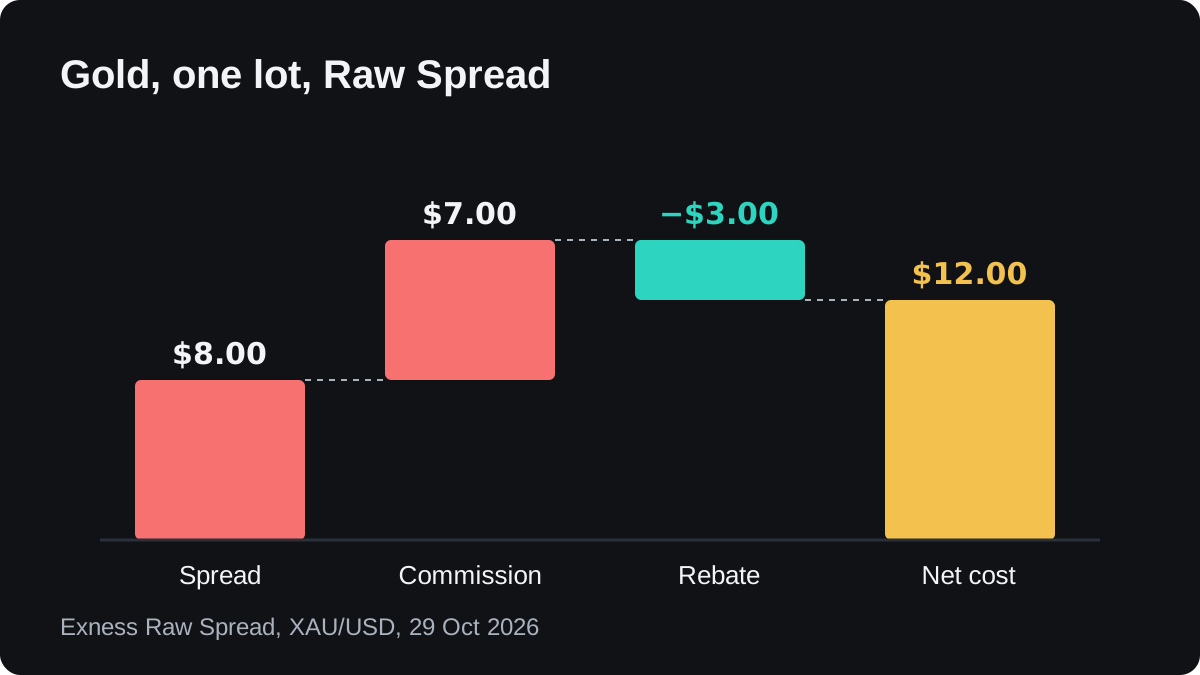
On a 100 ounce lot, every $1.00 move in the gold price is worth $100. So breakeven is $15.00 ÷ $100 = a $0.15 move without the rebate, and $12.00 ÷ $100 = a $0.12 move with it.
Notice the rebate covers a smaller share here, 20% against 40.5% on the first example. Accounts differ a lot, which is why comparing Standard and Raw accounts only makes sense with all three numbers: spread, commission and rebate.
What a rebate cannot do
It cannot rescue a strategy that loses money before costs. If a system loses $30 a lot on average before any costs, a smaller cost only slows the bleeding.
It also leaves slippage and swap untouched. A trade that slips 1 pip on entry costs you $10 more on a standard EUR/USD lot, rebate or not.
Run your own numbers
The trading calculator takes your pair, account type and volume and returns the spread, commission, rebate estimate and net cost of one trade. Use it with your real lot sizes, not round ones.
Questions
How do I calculate breakeven with a rebate?
Add the spread cost and commission for one lot, subtract the rebate per lot, then divide by the pip value per lot. The result is the number of pips price must move to cover costs.
Does the rebate show in my open trade's profit?
No. The platform shows the full spread and commission while the trade is open. The rebate is counted when the lot closes and is paid into the account afterwards.
Is a raw spread account always cheaper with a rebate?
Not always. Compare spread plus commission minus rebate for each account type on the pairs you actually trade, since the answer changes from pair to pair.
Does a rebate cover swap fees?
No. Swap is charged separately on positions held overnight, and a rebate only offsets the spread and commission side of the cost.
Keep learning
 Chapter 1What is a forex rebate?A forex rebate is money paid back to you for every lot you trade. It comes from the commission a broker pays the partner who introduced your account, and that partner passes some or all of it back. You trade the same way at the same spread, and the cash arrives per closed lot.
 Chapter 1Where do forex rebates come from?A forex rebate comes from the introducing commission a broker pays the partner who referred your account. That commission is funded by the spread and fees you already pay. The partner passes part or all of it back to you, so you pay nothing extra and your trading conditions stay as they are.
 Chapter 1Rebate vs bonus: what is the difference?A rebate is cash returned for every lot you trade, paid into your balance and withdrawable like any other money. A deposit bonus is usually trading credit sized to your deposit, often with a volume target before any of it can be withdrawn, and it can be removed when you take money out.
 Chapter 1How do you move a forex account to a new IB?Moving an account to a new introducing broker changes one thing: the partner the broker pays commission to. Your balance, open positions, spread and leverage stay where they are. Brokers usually offer two routes, a partner change on the existing account or a new account opened under the new partner.
 Chapter 1What are the red flags of a forex rebate service?A sound rebate service only needs your account number to track volume, and the broker pays the rebate into your trading account. Warning signs are requests for your trading password, offers to hold your money, rates with no stated source, slow or unexplained payouts, and pressure to deposit through a private wallet.
 Chapter 1Forex rebates cheat sheet.A forex rebate returns part of the commission your broker pays the introducing partner, per lot you trade. It lowers your net cost and your breakeven distance without changing your spread. This page sums up the chapter: the key formulas, real rates read on 29 October 2026, the switching steps and the warning signs.

