How to start trading crypto.
To start trading crypto, first decide whether you want to own coins on an exchange or trade the price through a broker's CFDs. Then secure the account with 2FA, learn what each trade costs, practise on a demo or with tiny sizes, and set a fixed risk per trade before you choose a coin.

Say you put $500 into a coin that is trending online, and by the next morning it is worth $400. You sell in a hurry, and a week later the price is back where you bought it.
You had no plan for how much to buy or where to get out if the price fell, so fear made both decisions.
This lesson puts those decisions in order. All numbers are round figures for illustration.
Choose between owning coins and trading the price
There are two common ways in. On a crypto exchange you buy the coin itself. It belongs to you, and you can withdraw it to a wallet that you control.
Exchange markets run around the clock, weekends included. You pay a trading fee on each order, and if you only ever buy, you can only profit when the price rises.
The other way is a crypto CFD with a broker. A CFD is a contract with the broker that settles the change in price in cash, whichever way it moves.
You own no coins and need no wallet, and selling short is as easy as buying. CFDs usually come with leverage, and many charge a fee, called swap, for each night a position stays open.
The broker sets the trading hours, including what happens at weekends, and lists them in its contract specification.
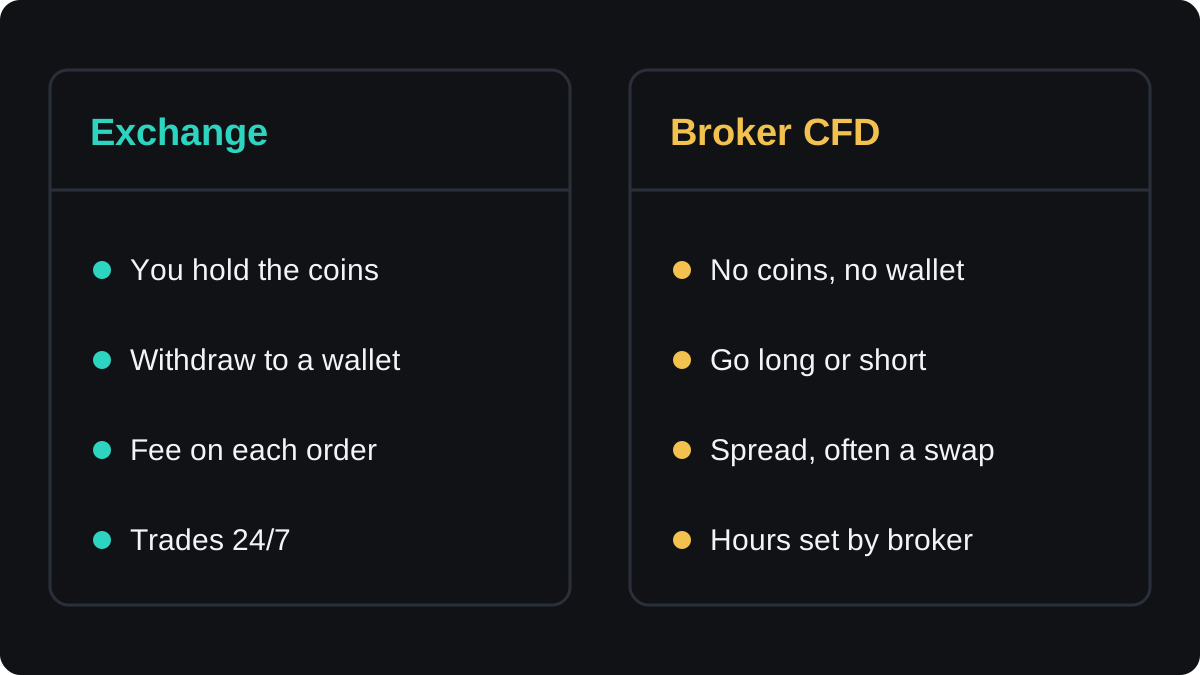
Neither route suits everyone. Holding coins for years points to an exchange. Trading short moves in both directions, perhaps next to forex in one account, points to a CFD.
The lesson on buying coins vs trading CFDs compares them in detail.
Open the account and lock it down
Regulated exchanges and brokers check your identity when you open the account. This is called KYC, short for know your customer: you upload an ID document, and often a proof of address or a selfie.
Turn on two-factor authentication (2FA) with an authenticator app as soon as the account opens. Use a password that you use nowhere else.
Then make a small deposit and a small withdrawal before anything else. You learn how long money takes to move and what each step costs, and you find out early whether the platform pays out as promised.
Ignore anyone who offers to trade for you or promises a fixed return. Real markets do not pay fixed returns, and those offers are a common way people lose their deposit.
Learn what each trade costs
Every trade costs something, even when the app shows no separate fee. On an exchange you pay a trading fee as a share of each order, and you also pay the spread, the gap between the buying and selling price.
Here is an illustrative round trip. You buy $1,000 of a coin and later sell at an unchanged market price. The fee is 0.1% on each side, and the spread is 0.1%.
- Fee on the buy: 0.1% of $1,000 = $1.00.
- Spread: you buy at the ask and sell at the bid, which costs 0.1% of $1,000 = $1.00.
- Fee on the sell: 0.1% of about $999 = about $1.00.
- Total: about $3.00, or 0.3% of the trade.
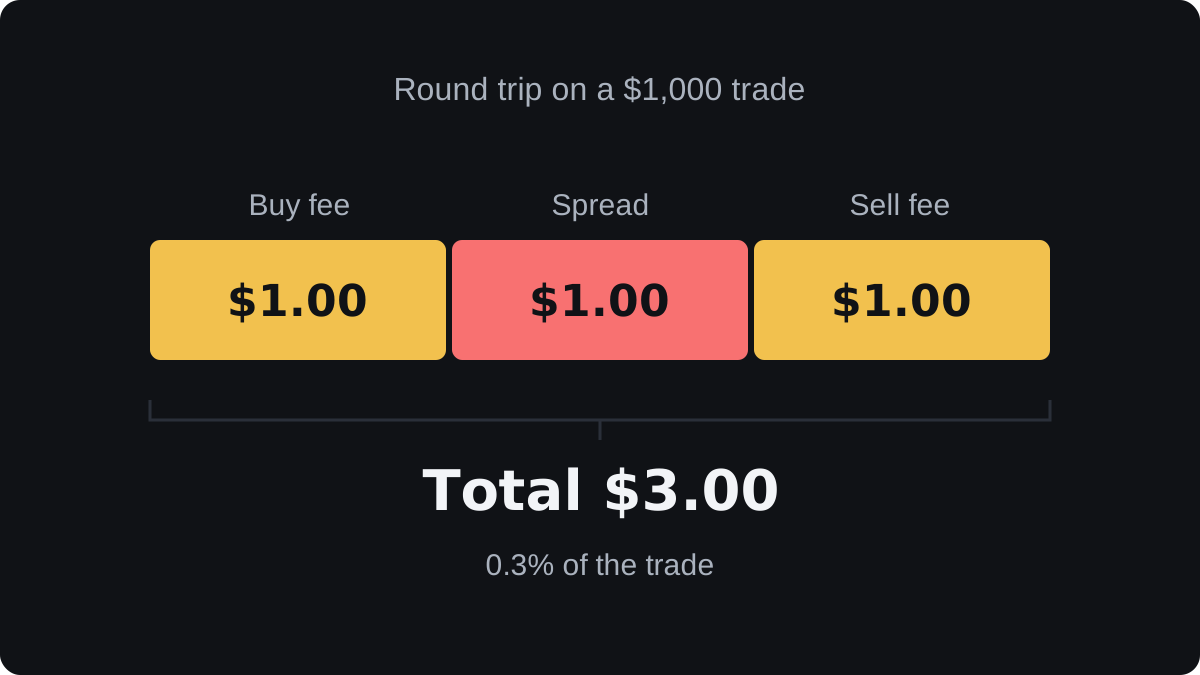
So the price has to rise about 0.3% before you break even. Sending coins out to a wallet adds a network fee on top.
With a CFD, the main costs are the spread, any commission and a swap for each night you hold. The lesson on crypto CFD costs shows where to read each one.
If you trade crypto CFDs at Exness, a rebate that the broker pays into your trading account can return part of that cost, as the Exness page explains.
Practise, then start small
Many CFD brokers offer a demo account with virtual money. Where there is no demo, you can paper trade: write each planned order down and check later what it would have done.
A demo teaches you the buttons and the order types. It cannot teach you how a real loss feels, so keep your first live trades small enough that a loss does not hurt.
Set your risk before you pick a coin
Decide first how much of the account one trade may lose. A common convention is to risk 1% to 2% of the balance on each trade.
It is a rule of thumb, and no single figure suits every trader. The lesson on risk per trade explains the reasoning.
Say your account holds $2,000 and you risk 1%. You want to buy a coin at $100, with a stop loss at $90.
- Risk: 1% of $2,000 = $20.
- Stop distance: $100 minus $90 = $10 per coin, which is 10% of the price.
- Size: $20 ÷ $10 = 2 coins.
- Position value: 2 × $100 = $200.
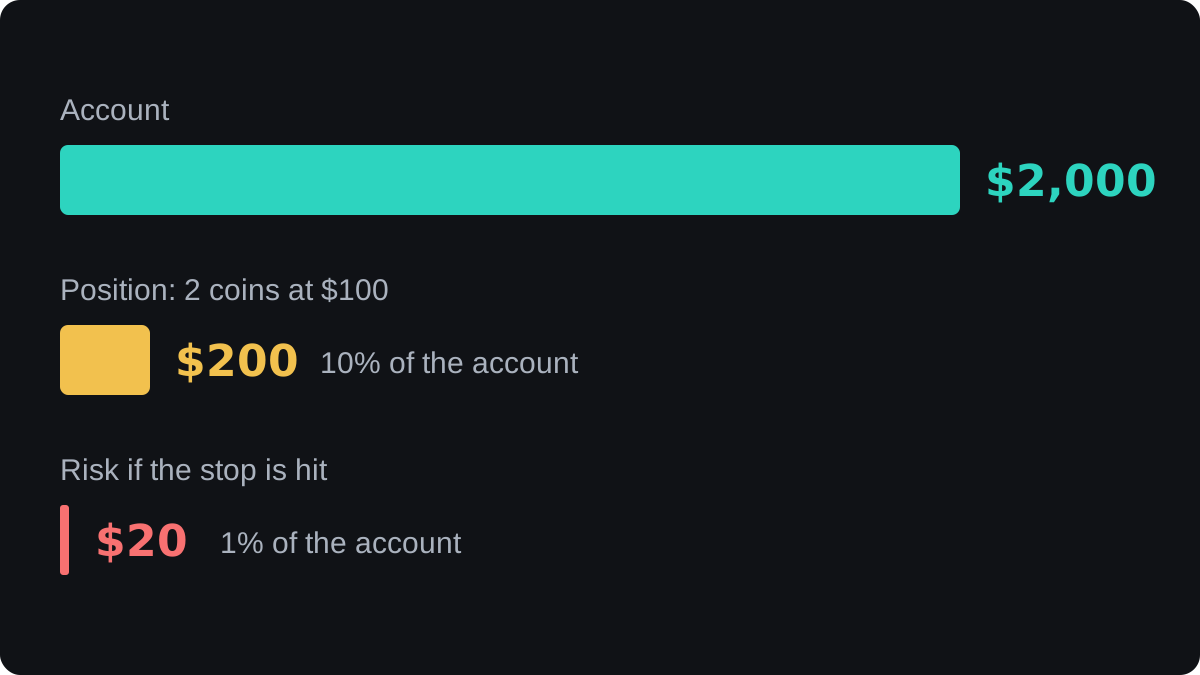
If the stop is hit, you lose about $20 plus fees.
Crypto prices can move 10% in a day, so stops often sit further away than in forex, and positions come out smaller. The lesson on position sizing for crypto covers more cases.
Write the plan down and keep records
Put your choices on one page: the coins you trade, the route, your risk per trade and the most you will lose in a day before you stop for that day.
The lesson on what goes into a trading plan covers the rest of the page.
Then record every trade, with the entry, stop, exit, fees and the reason you took it. The crypto trading journal lesson lists the fields worth keeping.
Questions
How much money do I need to start trading crypto?
Coins can be bought in small fractions, so you can start with a small amount. Use money you can afford to lose in full, and size each trade so that one loss is a small share of it.
Is it better to buy crypto or trade crypto CFDs?
It depends on what you want. Buying suits holding coins for a long time. CFDs suit trading shorter moves in either direction, with leverage that makes losses larger as easily as gains.
Can I start trading crypto on a demo account?
Yes, many CFD brokers offer one. A demo teaches the platform and the order types, but it will not show how you react when real money is falling.
Do I need a crypto wallet to start trading?
You do not need one to trade. An exchange account holds coins for you, and a CFD involves no coins at all. You need your own wallet only if you want to withdraw coins and hold the keys yourself.
What should my first crypto trade look like?
It should be small and planned in advance, with a stop loss and a size worked out from your risk limit. The point of the first trades is to learn the process without a loss that matters.
Keep learning
 Chapter 2Crypto trading principles that hold up.The crypto trading principles that hold up rest on arithmetic and behaviour, so they apply to any coin. Risk a small fixed share of the account on each trade, let the stop decide the size, expect fills worse than your stop, size the trade before leverage, count every fee, and keep your money safe outside the trade.
 Chapter 2How to build a crypto trading strategy.To build a crypto trading strategy, choose one market, instrument and timeframe, then pick one idea you can explain, such as following trends. Write exact rules for the filter, entry, stop, target and size, so every number comes from the rules. Test them on past prices with fees included, then forward test before risking real money.
 Chapter 2A crypto trade from plan to exit.This example follows one bitcoin trade with round illustrative numbers. A $10,000 account risks 1%, so $100. Entry is $60,000, the stop $57,500 and the target $65,000, which gives a size of 0.04 BTC. The target is hit, and after $5 of fees the result is $195, or 1.95 times the amount risked.
 Chapter 2How to keep a crypto trading journal.Keep a crypto trading journal by writing the plan before each trade: venue, pair, setup, entry, stop, target, size in coins and risk in money. After the exit, record each fee as charged, the net result and R, and whether you followed the plan. Log deposits, withdrawals and wallet moves in a separate transfer log.

