Should you buy or create NFTs?
That depends on what you want the token for. A buyer should know what the token gives, who would buy it back and at what price, and whether losing the full amount is acceptable. A creator needs the rights to the work, an audience, and room in the budget for minting and selling fees.
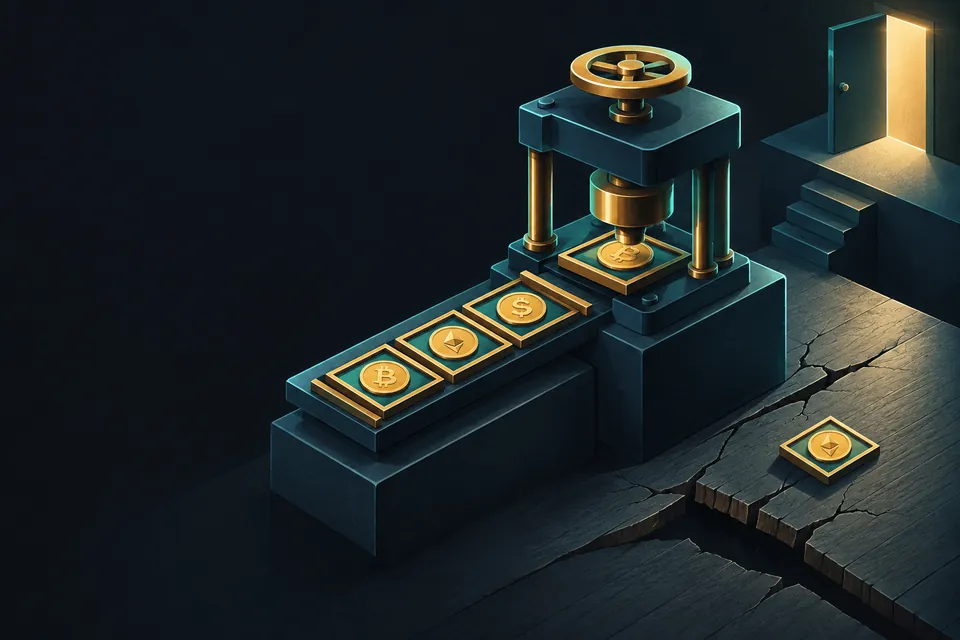
Asking whether NFTs are worth buying is like asking the same of tickets. It depends on the ticket. A pass to an event you want to attend differs from a picture bought because its price rose last week.
This lesson gives you the questions and the arithmetic. The answer depends on your own reasons and your own money.
What are you buying it for?
Most purchases fall into two groups. Some buyers want the token for itself, such as a ticket or a piece of art they like. Others want to sell it later for more.
The first group can judge the price on its own terms: is the event or the art worth that much to you? The second group is betting on future demand, and that bet rests entirely on other people.
Before buying, answer these:
- What does the token give me, and who keeps that promise running?
- Where are the metadata and image stored, and could they change or vanish?
- How many real offers exist right now, and at what price?
- Could I lose the full amount without it changing my plans?
An NFT pays no interest or dividend. Its price is whatever the next buyer will pay, and that can fall to nothing when attention moves on. The lesson on crypto volatility shows how large ordinary swings in crypto can be.
Worked example: floor price versus a real exit
The numbers below are illustrative.
- A collection has 10,000 tokens. 50 are listed for sale, and the cheapest asks 0.20 ETH. That is the floor price.
- You buy at the floor and pay 0.005 ETH in network fees, 0.205 ETH in total.
- The next day you need to sell. The highest standing offer is 0.12 ETH.
- After 7.5% in marketplace fees and royalty, accepting it leaves 0.12 × 0.925 = 0.111 ETH.
- Accepting an offer is a transaction you send, so you pay another 0.005 ETH network fee. You end with 0.111 minus 0.005 = 0.106 ETH.
- Your loss is 0.205 minus 0.106 = 0.099 ETH, about 48% of what you paid, even though the floor never moved.
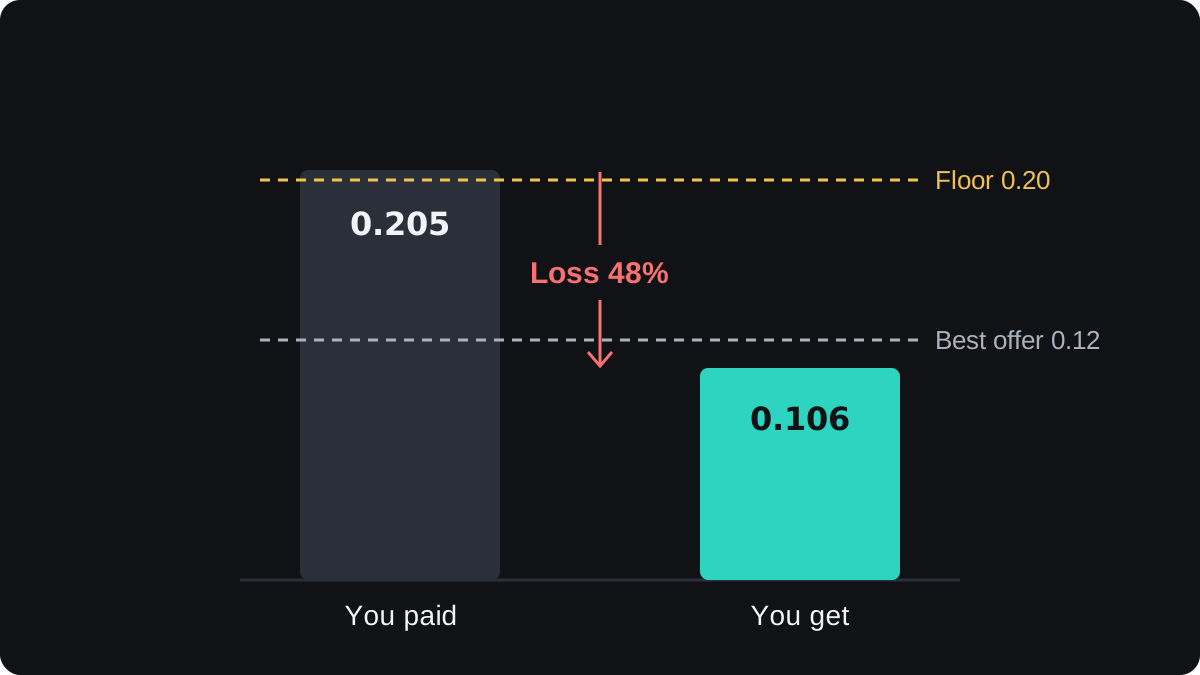
Sites often multiply the floor by the supply: 10,000 × 0.20 = 2,000 ETH. That figure describes nobody's real exit. Only 50 tokens are for sale, and the offers below them show what buyers will pay.
The lesson on how buying an NFT works explains the floor price and the fees in this example.
What creating an NFT involves
Creating an NFT is called minting. You upload the file, write the metadata, choose where to store both, and send a transaction that creates the token.
Deploying your own smart contract costs more in network fees and keeps the collection under your address. Minting into a shared contract run by a platform costs less and ties your tokens to that platform.
Some platforms offer lazy minting: the token is only created when someone buys it, and the buyer's transaction pays the network fee. You pay no network fee up front, and an unsold piece never touches the chain.
You can write a royalty into the contract, but paying it is up to each marketplace. Plan as if the first sale is the only one that pays you.
Worked example: an edition of 100
The numbers below are illustrative. Network fees in particular vary widely between networks and from day to day.
- You plan an edition of 100 tokens at 0.02 ETH each. Deploying your own contract costs 0.10 ETH in network fees.
- If all 100 sell, you take in 100 × 0.02 = 2.00 ETH. The marketplace keeps 2.5%, which is 0.05 ETH. After the contract cost you keep 2.00 minus 0.05 minus 0.10 = 1.85 ETH.
- If only 20 sell, you take in 20 × 0.02 = 0.40 ETH. Minus 2.5% (0.01 ETH) and the same 0.10 ETH, that leaves 0.29 ETH.
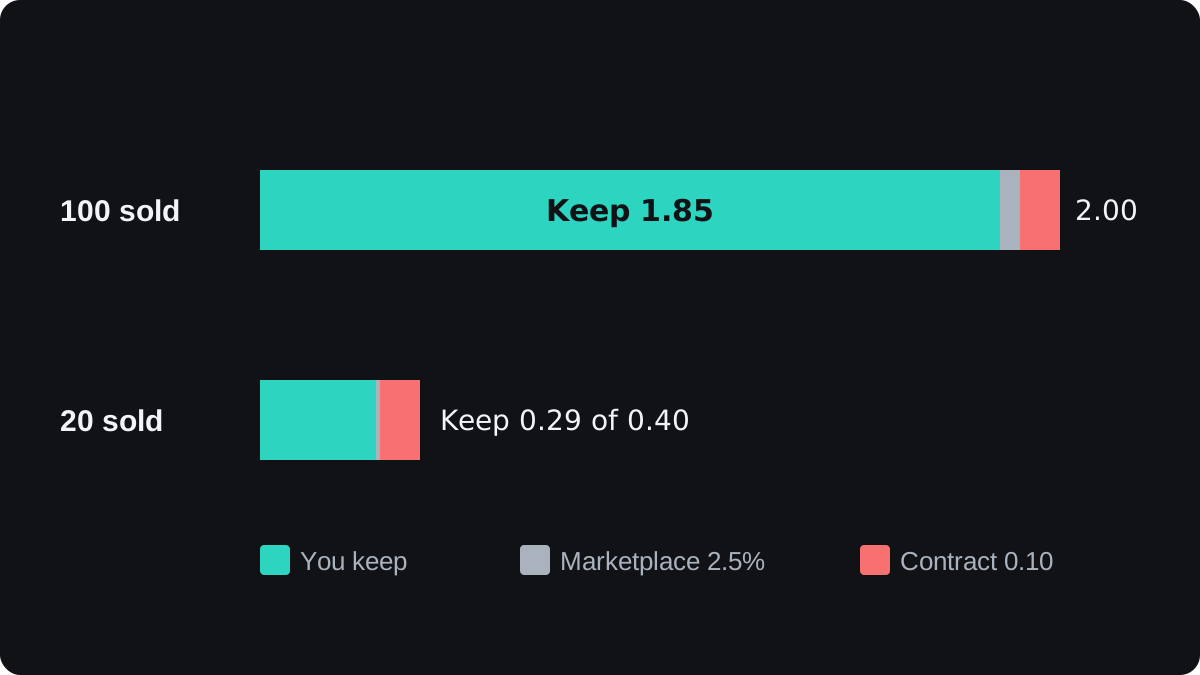
When 100 sell, the contract cost is 5% of sales. When 20 sell, it is 25%. Lazy minting, or a network with lower fees, shrinks that fixed cost, with the trade-offs described above.
Rights, records and rules
Mint only work you hold the rights to. Minting someone else's art or photos without permission can infringe their copyright, whatever the blockchain records, and marketplaces can delist such tokens when the owner complains.
Tell buyers what they get. A short licence that says whether holders may display the work, print it or sell products with it saves disputes later.
Keep a record of every mint, sale and fee. Many countries tax NFT sales as income or as gains, and the rules differ by country and change over time, so check the ones that apply to you.
Where buyers and creators get hurt
Buyers lose money in a rug pull: a team sells a collection on promises, such as a game or a roadmap, then stops work and keeps the money. The tokens still exist, but nothing stands behind them.
Creators get impersonated: scammers copy a creator's page and run a fake mint under their name. A hacked social account is worth a lot to them, because it can post a fake mint link to a real audience.
The lessons on common crypto scams and protecting yourself from them cover both sides.
Questions
Are NFTs a good investment?
An NFT produces no income, so its price depends only on what the next buyer will pay. That price can fall to zero and selling can be slow, so any money you put in can be lost in full.
How much does it cost to create an NFT?
You pay the network fee for minting or for deploying a contract, plus storage, and marketplace fees when it sells. With lazy minting, the first buyer pays the network fee instead.
Can I sell an NFT made from someone else's picture?
Not legally, unless you hold the rights. The blockchain record does not change copyright law, and marketplaces can delist infringing tokens.
Do I earn royalties forever on my NFT?
Only where a marketplace or the contract enforces them. Some marketplaces make royalties optional for the seller, so treat them as a possible extra.
Keep learning
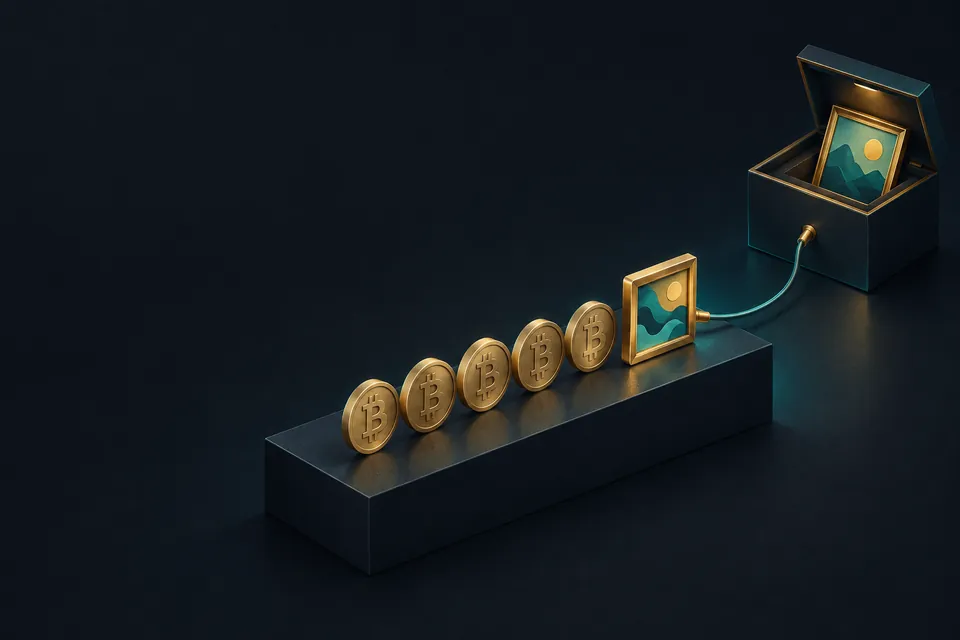 Chapter 2What is an NFT?An NFT, or non-fungible token, is a token on a blockchain with its own ID number, so no two are interchangeable. The blockchain records which address holds it. The token usually points to a file of details, called metadata, which links to an image or other item. Holding the token does not by itself give you the copyright.
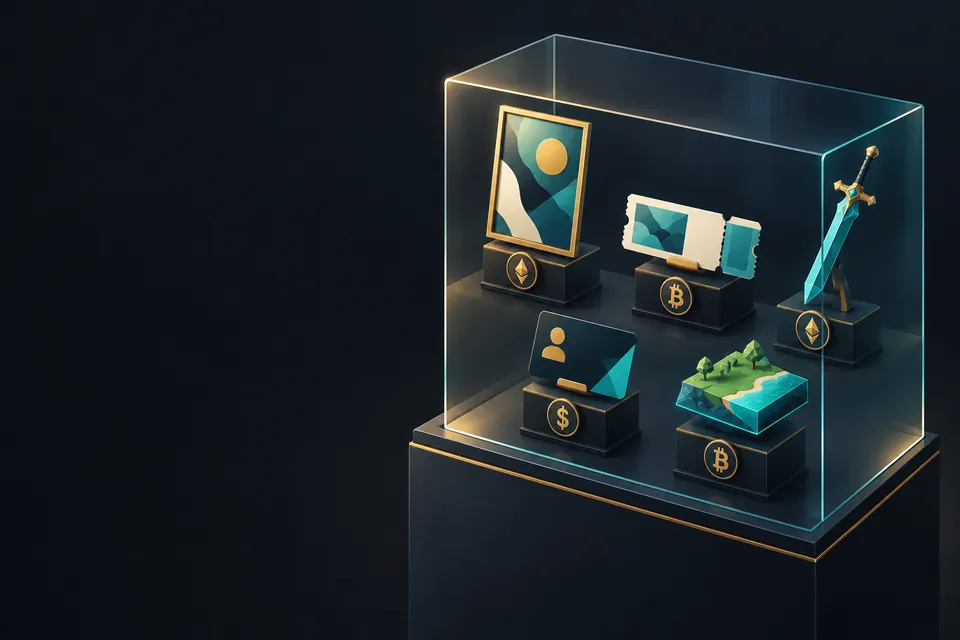 Chapter 2What are NFTs used for?NFTs are used wherever it matters who holds one specific item: digital art and collectibles, event tickets and memberships, items inside games, blockchain names, and receipts for positions or physical goods. In each case the token proves which address holds the item, and the use depends on someone outside the chain honouring that record.
 Chapter 2How buying an NFT works.To buy an NFT you need a self-custody wallet holding the coin of the network the NFT lives on. You connect it to a marketplace or mint page, check the contract address, and confirm a transaction that pays the price plus a network fee. The token then moves to your address, and the payment cannot be reversed.

