What is an NFT?
An NFT, or non-fungible token, is a token on a blockchain with its own ID number, so no two are interchangeable. The blockchain records which address holds it. The token usually points to a file of details, called metadata, which links to an image or other item. Holding the token does not by itself give you the copyright.
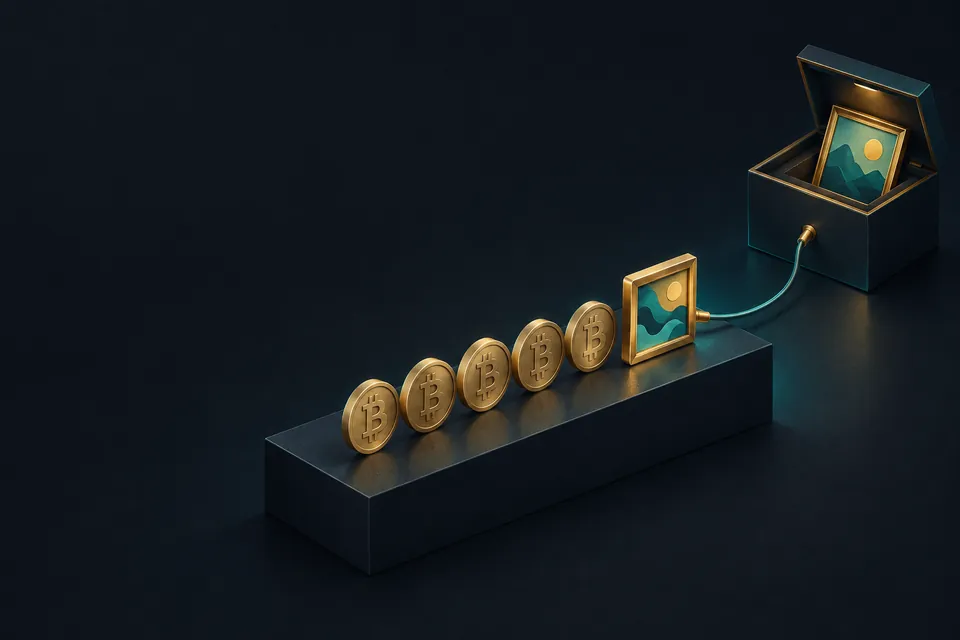
If you lend a friend 10 USDC, you do not care which 10 USDC come back. Any 10 will do. If you lend them your bicycle, you want that exact bicycle back, scratch on the frame and all.
Tokens on a blockchain can work either way. An NFT is the bicycle kind: a token with its own identity, so one cannot stand in for another.
Fungible and non-fungible tokens
A thing is fungible when every unit is the same as every other. Dollars and units of bitcoin or ether are fungible. Your wallet shows them as one number, such as 250 USDC.
NFT stands for non-fungible token. Each one is named by two things: the smart contract that created it and a token ID inside that contract.
No two tokens share that pair, even when their pictures look alike. Your wallet lists them one by one: token #12, token #407.
Many NFTs live on Ethereum and networks built like it, where the usual standard is called ERC-721. A second one, ERC-1155, lets one contract hold unique items and items with many identical copies, such as 500 tickets.
Other blockchains have standards of their own. Because the standards are shared, any wallet or marketplace that supports them can read the tokens, whoever created them.
What you actually own
An NFT is a short entry in a contract's records. The entry says that token 42 in this contract belongs to this address. That part is on the blockchain, and you control it with your private key.
The contract also gives a link for each token. The link points to a text file called metadata, which usually lists a name, a description, a set of traits and a link to the image, video or other file.
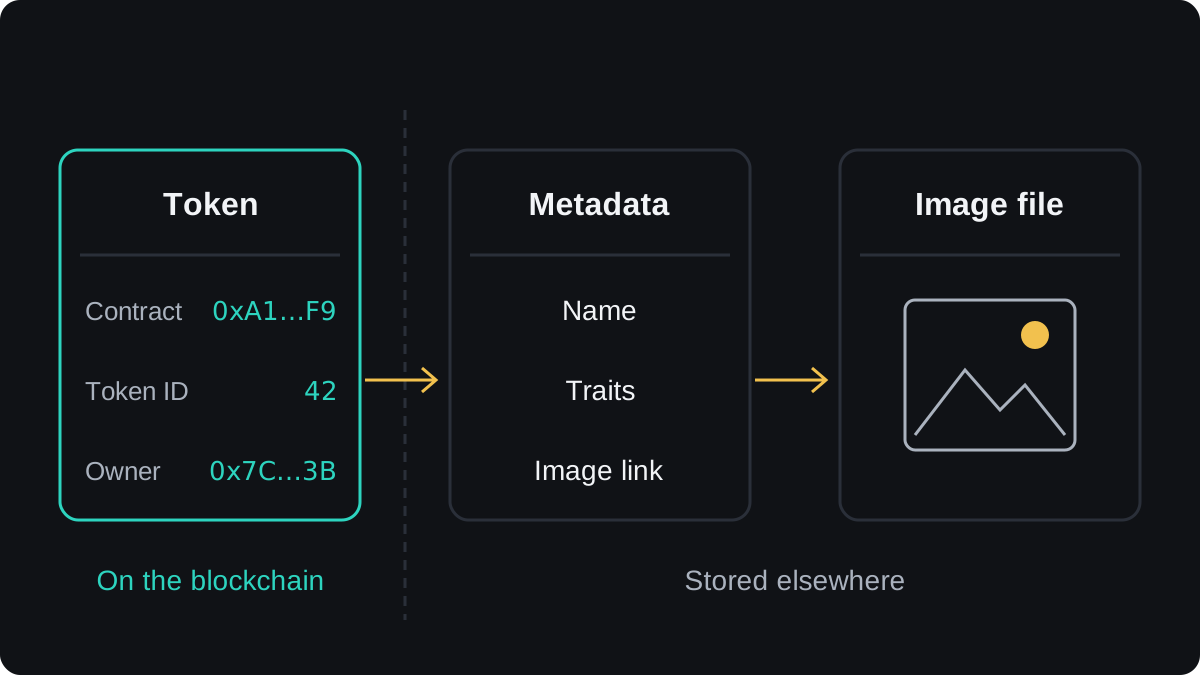
So most NFTs have three layers: the token, the metadata and the media file. Only the token is guaranteed to stay where it is. The other two sit wherever the creator chose to store them.
Where the image lives, and why it matters
Images are large, and storing data on a blockchain costs a fee for every byte. So most NFTs keep only a link on-chain, and where that link points decides how long the item lasts.
On-chain storage puts the image, or the code that draws it, inside the contract itself. It lasts as long as the blockchain does. Few projects do it, because of the cost.
IPFS is a file-sharing network where the link is built from a hash of the file. Change one pixel and the link changes, so nobody can swap the file quietly. It stays reachable only while someone keeps a copy online.
An ordinary web address is the weakest option. Whoever runs the server can replace the image or let the site lapse, and your token then points at an empty page.
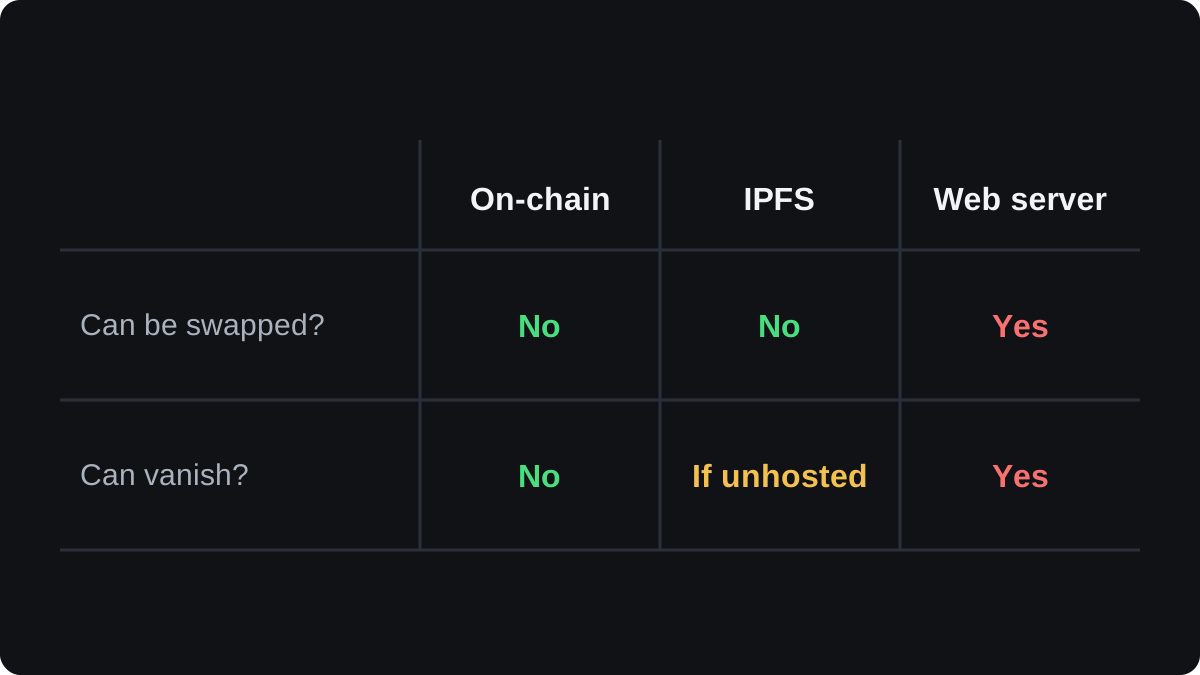
You can check this yourself. A block explorer can read the token's link from the contract, and a link that starts with ipfs:// or holds the data directly is harder to tamper with than a plain web address.
What the token gives you, and what it does not
The token gives you control. You can move it to another address or sell it, and anyone can trace every address that has held it on a block explorer.
The copyright usually stays with the creator. What you may do with the artwork depends on the licence the project publishes, and licences differ between collections. Read it before you print the image on T-shirts.
Holding the token does not stop copies either. Anyone can save the picture. What they cannot copy is the record that your address holds token 42 in the original contract, and that record is what buyers pay for.
Worked example: rarity in a collection
Many NFTs come in collections of thousands of tokens built from the same parts. The traits in each metadata file decide how rare a token is. The numbers below are illustrative.
- A collection has 10,000 tokens.
- 100 of them have a gold background. That is 100 ÷ 10,000 = 1% of the collection.
- 2,000 of them wear a hat, which is 2,000 ÷ 10,000 = 20%.
- If the two traits were handed out independently, about 1% × 20% = 0.2% would have both. That is 0.002 × 10,000 = 20 tokens.
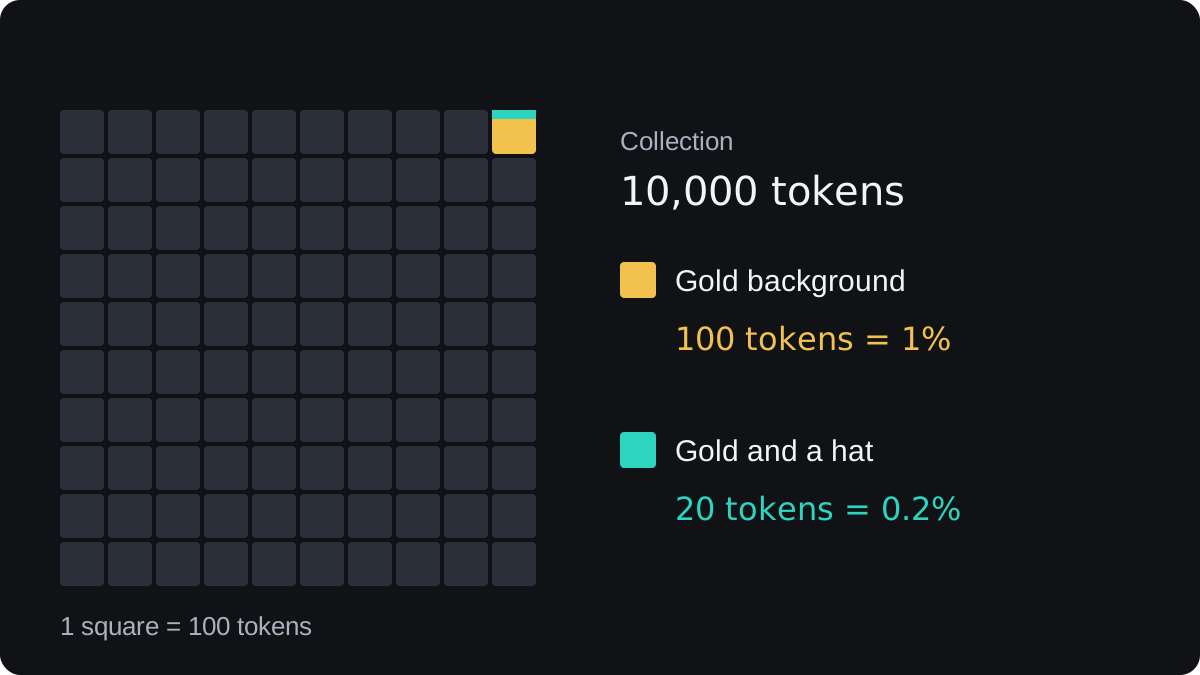
Rarity is set by the creator's code, so it describes supply only. It says nothing about how many people want the token, and demand sets the price. A rare token in a collection nobody follows can still find no buyer.
The next lessons cover what NFTs are used for and how buying one works.
Questions
Is an NFT the same as a cryptocurrency?
Both are tokens on a blockchain. A unit of a cryptocurrency is fungible, so any unit equals any other, while each NFT has its own ID and cannot be swapped one for one.
Can an NFT be copied?
Anyone can copy the image. Nobody can copy the token: the record that a given address holds a given ID in a given contract exists once on the blockchain.
Do I own the copyright when I buy an NFT?
Usually not. You own the token, and your rights to the artwork follow whatever licence the creator published, which differs between projects.
What happens to my NFT if the project's website goes down?
The token stays on the blockchain at your address. If the metadata or image was hosted on that website, the token may now point at a broken link, which is why storage matters.
Where is an NFT stored?
The token is a record on the blockchain, controlled by the keys in your crypto wallet. The image usually sits elsewhere, on IPFS or a web server, linked from the metadata.
Keep learning
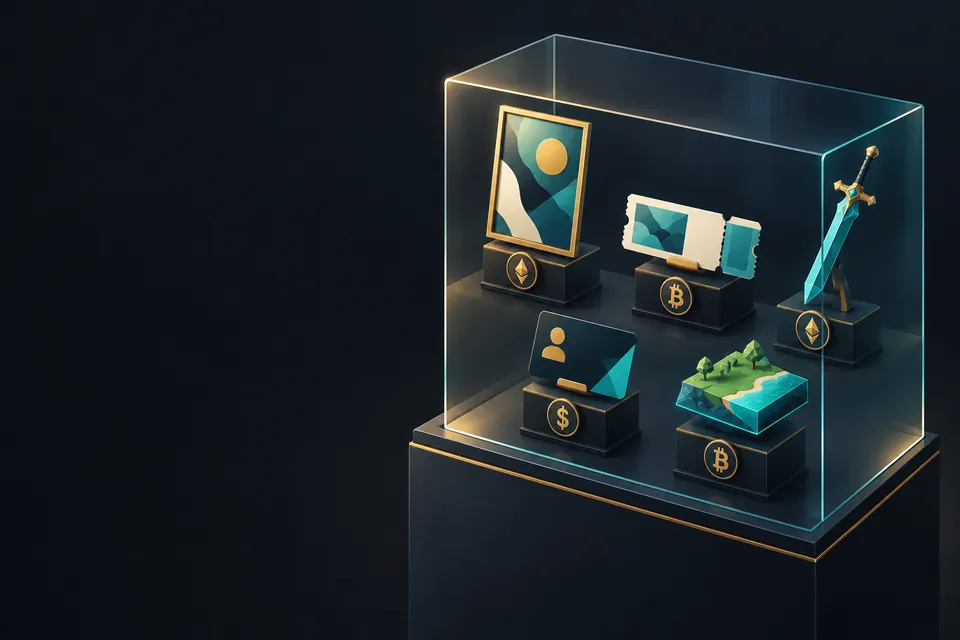 Chapter 2What are NFTs used for?NFTs are used wherever it matters who holds one specific item: digital art and collectibles, event tickets and memberships, items inside games, blockchain names, and receipts for positions or physical goods. In each case the token proves which address holds the item, and the use depends on someone outside the chain honouring that record.
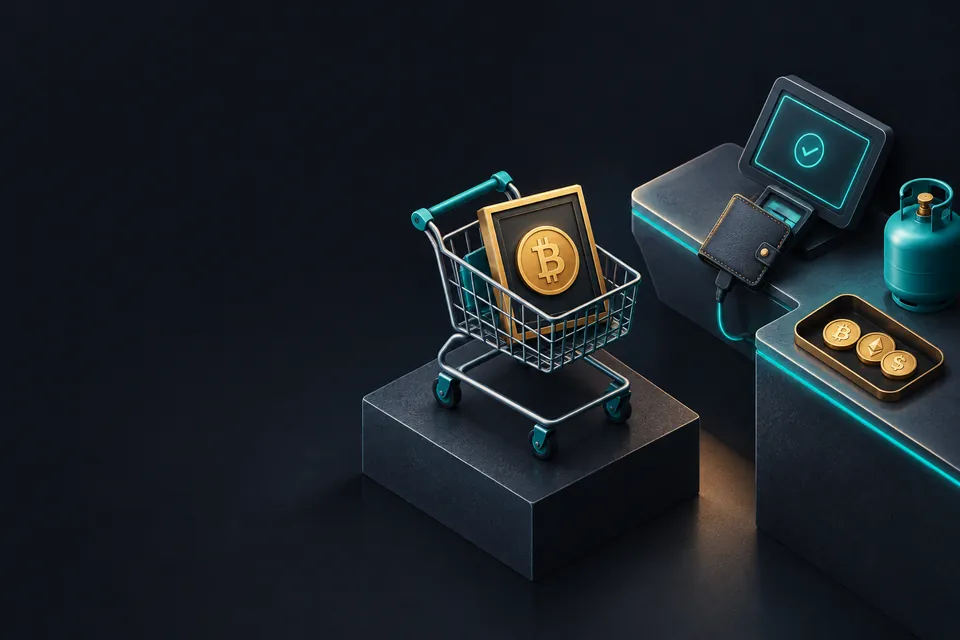 Chapter 2How buying an NFT works.To buy an NFT you need a self-custody wallet holding the coin of the network the NFT lives on. You connect it to a marketplace or mint page, check the contract address, and confirm a transaction that pays the price plus a network fee. The token then moves to your address, and the payment cannot be reversed.
 Chapter 2Should you buy or create NFTs?That depends on what you want the token for. A buyer should know what the token gives, who would buy it back and at what price, and whether losing the full amount is acceptable. A creator needs the rights to the work, an audience, and room in the budget for minting and selling fees.

