What are NFTs used for?
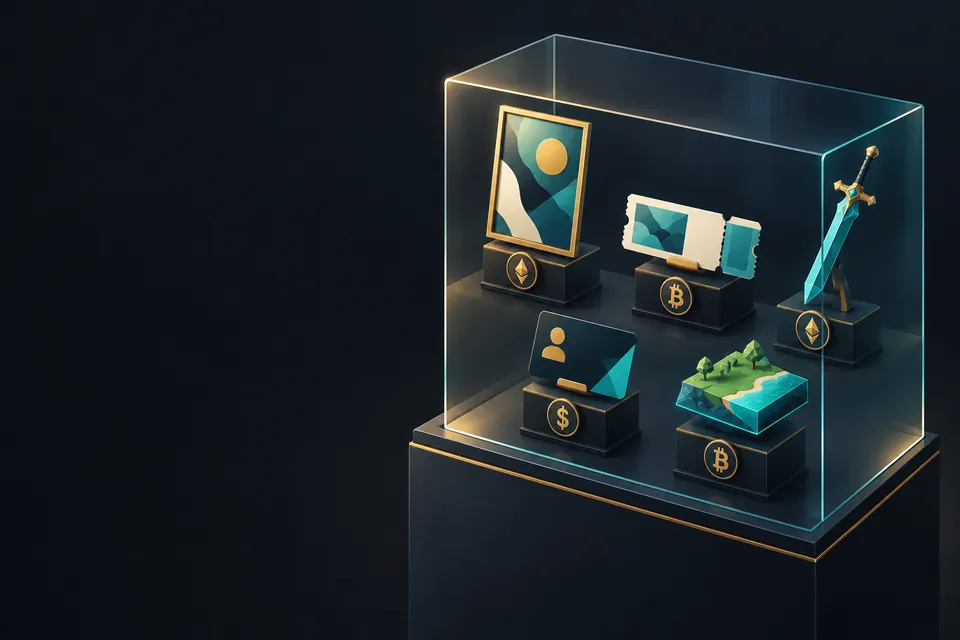
NFTs are used wherever it matters who holds one specific item: digital art and collectibles, event tickets and memberships, items inside games, blockchain names, and receipts for positions or physical goods. In each case the token proves which address holds the item, and the use depends on someone outside the chain honouring that record.
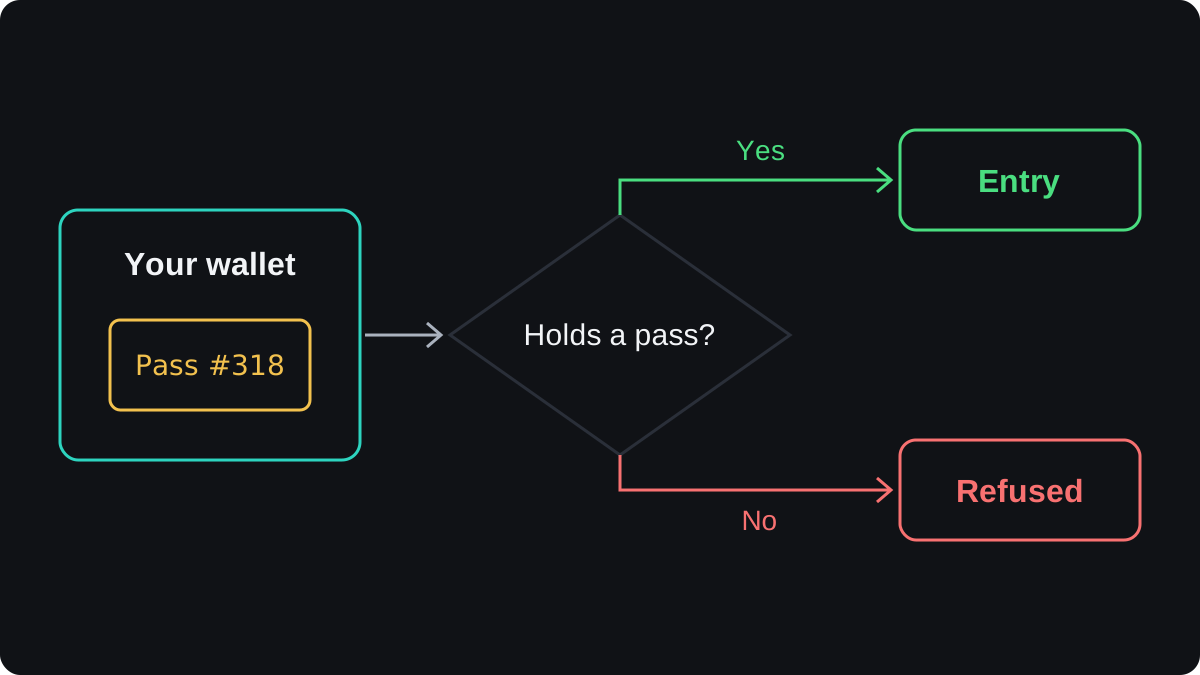
A conference sells 2,000 passes as NFTs. At the door, your wallet app signs a short message, and a program checks that the signing address holds one of those passes. Nobody asks for your name.
That pattern sits behind most NFT uses: a token that proves you hold one specific thing. The lesson on what an NFT is covers the token itself.
Digital art and collectibles
The best-known use is art. An artist creates a work as a token, and anyone can see which address created it and every address that has held it since.
Collections are the other large group: thousands of tokens built from the same set of traits, often used as profile pictures. Digital trading cards and sports clips follow the same model, with a fixed number of each card.
That record matters for digital art. If the artist publishes their address, buyers can tell the original from a copy made by someone else.
The token does not stop copies of the image, and its price rests entirely on what other collectors will pay.
Tickets, passes and memberships
A ticket fits the model well, since each seat or entry is one specific item. The organizer can see which tokens were used, and you can send a ticket to a friend from your wallet.
Memberships work the same way. Holding the token opens a private chat or a members' discount, and selling the token passes the membership to the buyer. This is called token gating.
Some events also hand out free attendance badges as NFTs, a lasting record that you were there.
Worked example: a ticket with resale rules
A smart contract can carry rules that a paper ticket cannot. Say an organizer writes these into a ticket contract. The numbers are illustrative.
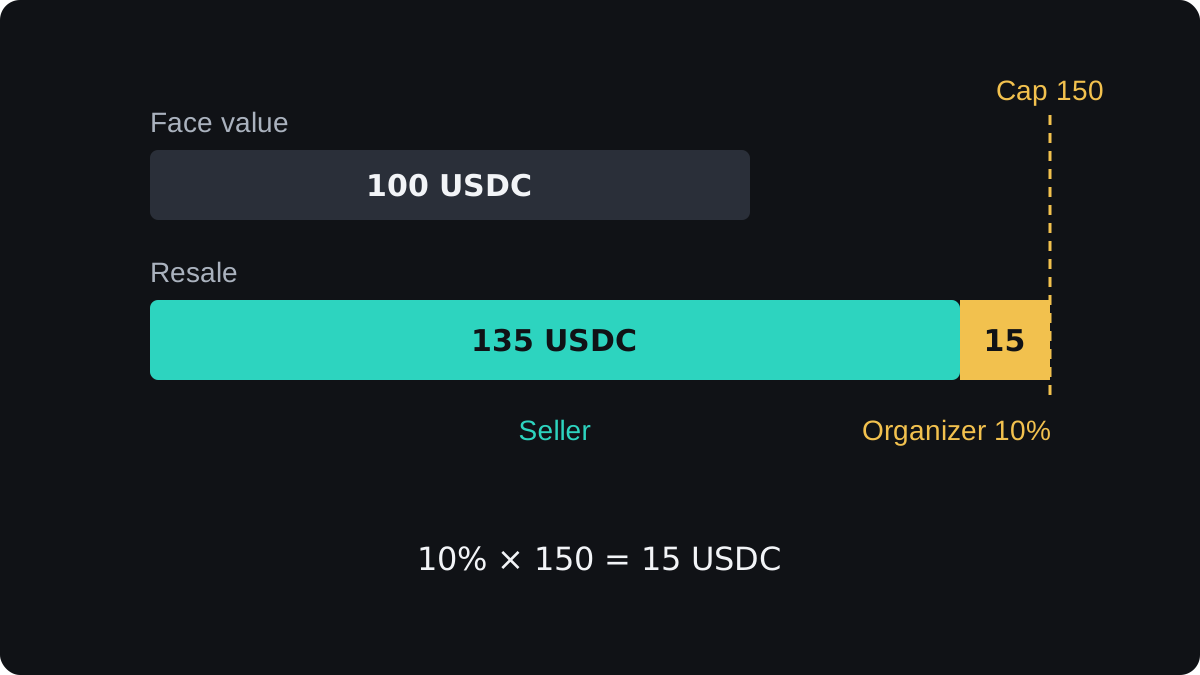
- Face value is 100 USDC, a stablecoin worth about one dollar.
- Resale is allowed up to 150% of face value, so 150 USDC at most.
- The organizer takes 10% of every resale.
You buy a ticket for 100 USDC and later resell it for the maximum, 150 USDC. The organizer receives 10% × 150 = 15 USDC. You keep 150 minus 15 = 135 USDC, 35 USDC more than you paid.
These rules hold only because the contract refuses transfers that skip them. Ordinary NFTs on open marketplaces have no such lock, so a creator's share of resales there depends on the marketplace choosing to pay it.
Game items, names and financial positions
In games, a sword or a plot of virtual land can be an NFT that you keep in your own wallet and sell to another player.
If the game closes, the token survives. Its use does not, because only the game's software gives the sword meaning.
Blockchain names are NFTs too. A name such as alice.eth points to a wallet address, so people can send coins to a word instead of a long address. Selling the name gives the buyer control of where it points.
Some decentralized exchanges give you an NFT as the receipt when you add tokens to a trading pool, because each position has its own settings, such as a price range. The lesson on automated market makers explains those pools.
Tokens can also stand for things off the chain, such as a watch in a vault. Then the token is only as good as the legal claim behind it and the company holding the item.
If the vault operator fails or disappears, the token alone cannot fetch the watch. Getting it back becomes a legal matter, settled off the chain.
A short history
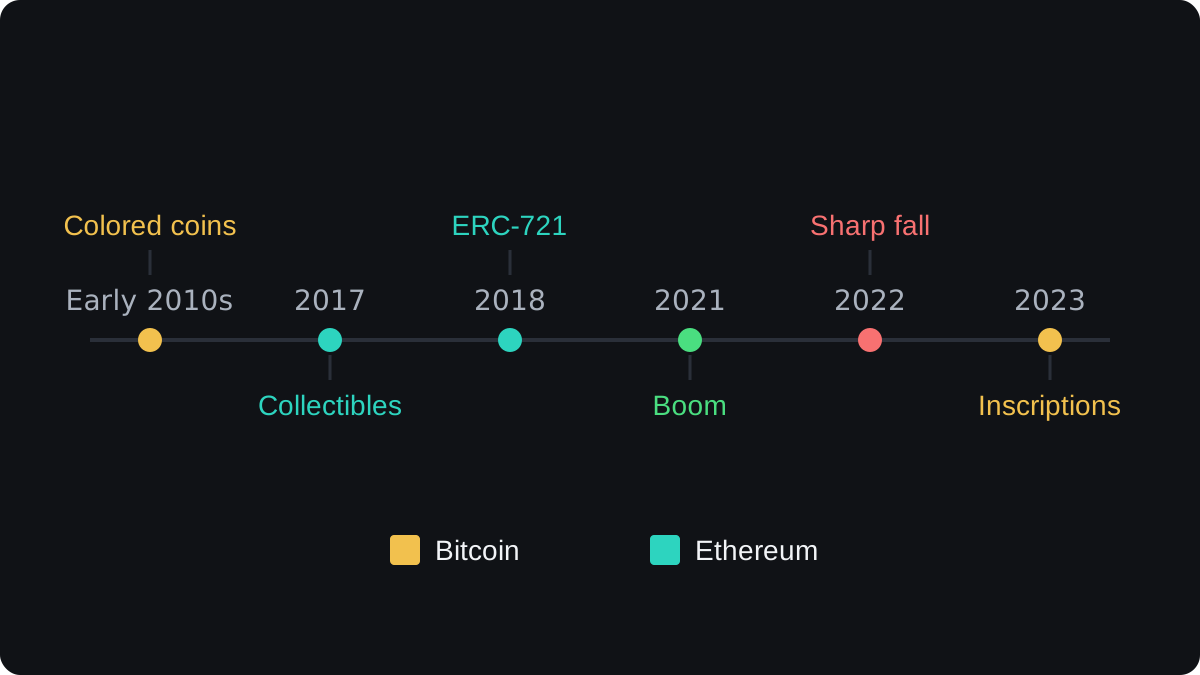
The idea is older than the name. In the early 2010s, projects on Bitcoin marked small amounts of bitcoin to stand for other assets, an approach called colored coins.
In 2017, collectible projects on Ethereum showed what unique tokens could do. One of them, CryptoKitties, a game of breeding digital cats, drew enough traffic to slow the network. The ERC-721 standard was finalized in 2018.
Trading in NFTs grew very fast in 2021 and fell steeply in 2022. In 2023, a method called inscriptions took off, bringing NFT-like items to Bitcoin itself.
Uses where holding the token does something, such as getting you through a door, do not depend on resale prices. If you are weighing a purchase, the lesson on how buying an NFT works covers the steps and the traps.
Questions
What are NFTs mainly used for?
Digital art and collectibles are the best-known use. Tickets, memberships, game items and blockchain names use the same kind of token for other purposes.
Can an NFT be used as a ticket?
Yes. Each ticket is a token, the door checks that your wallet holds it, and the contract can set resale rules such as a price cap.
Are NFTs only for art?
No. Any item where it matters who holds one specific unit can be an NFT, from a blockchain name to a position in a trading pool.
What happens to a game NFT if the game shuts down?
The token stays in your wallet, because it lives on the blockchain. Its use inside the game ends, since only the game's software gave it a purpose.
Does an NFT of a real object mean I own the object?
Only if a legal agreement says so and the company holding the object honours it. The token records who holds the claim; the vault and the contract terms decide what the claim is worth.
Keep learning
 Chapter 2What is an NFT?An NFT, or non-fungible token, is a token on a blockchain with its own ID number, so no two are interchangeable. The blockchain records which address holds it. The token usually points to a file of details, called metadata, which links to an image or other item. Holding the token does not by itself give you the copyright.
 Chapter 2How buying an NFT works.To buy an NFT you need a self-custody wallet holding the coin of the network the NFT lives on. You connect it to a marketplace or mint page, check the contract address, and confirm a transaction that pays the price plus a network fee. The token then moves to your address, and the payment cannot be reversed.
 Chapter 2Should you buy or create NFTs?That depends on what you want the token for. A buyer should know what the token gives, who would buy it back and at what price, and whether losing the full amount is acceptable. A creator needs the rights to the work, an audience, and room in the budget for minting and selling fees.

